Category: All Posts

  • Destination Checklist

    Destination Checklist

    This post is about my Checklist for Slow Travel Destinations.

    Destination Checklist

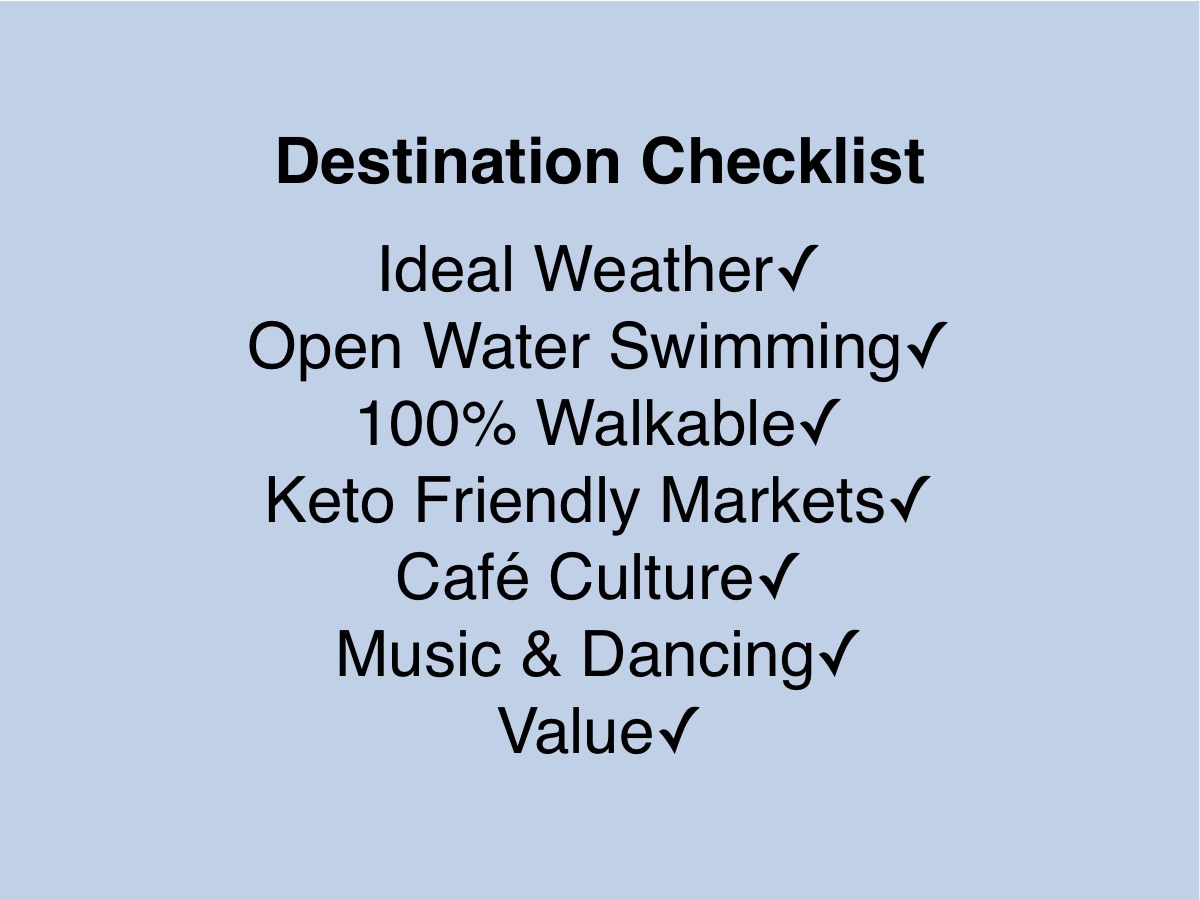
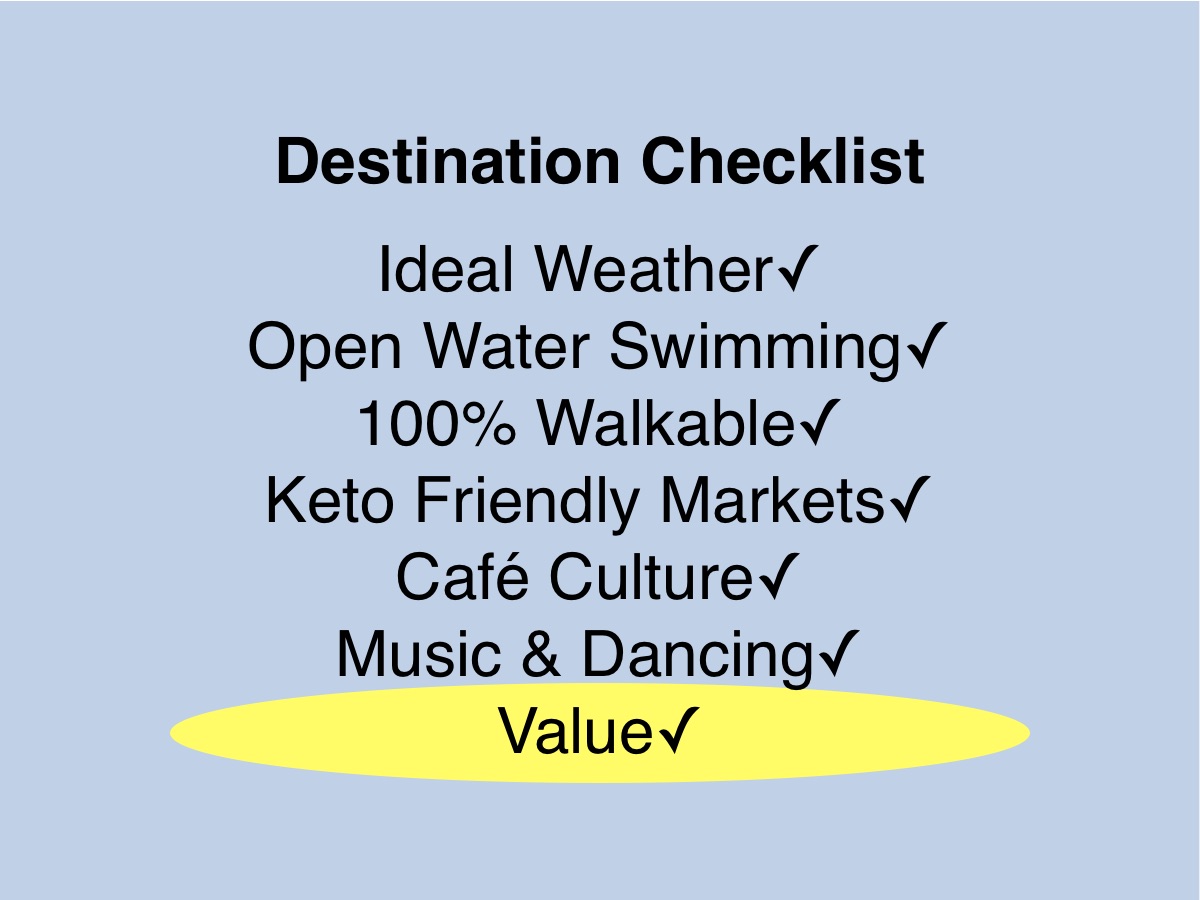
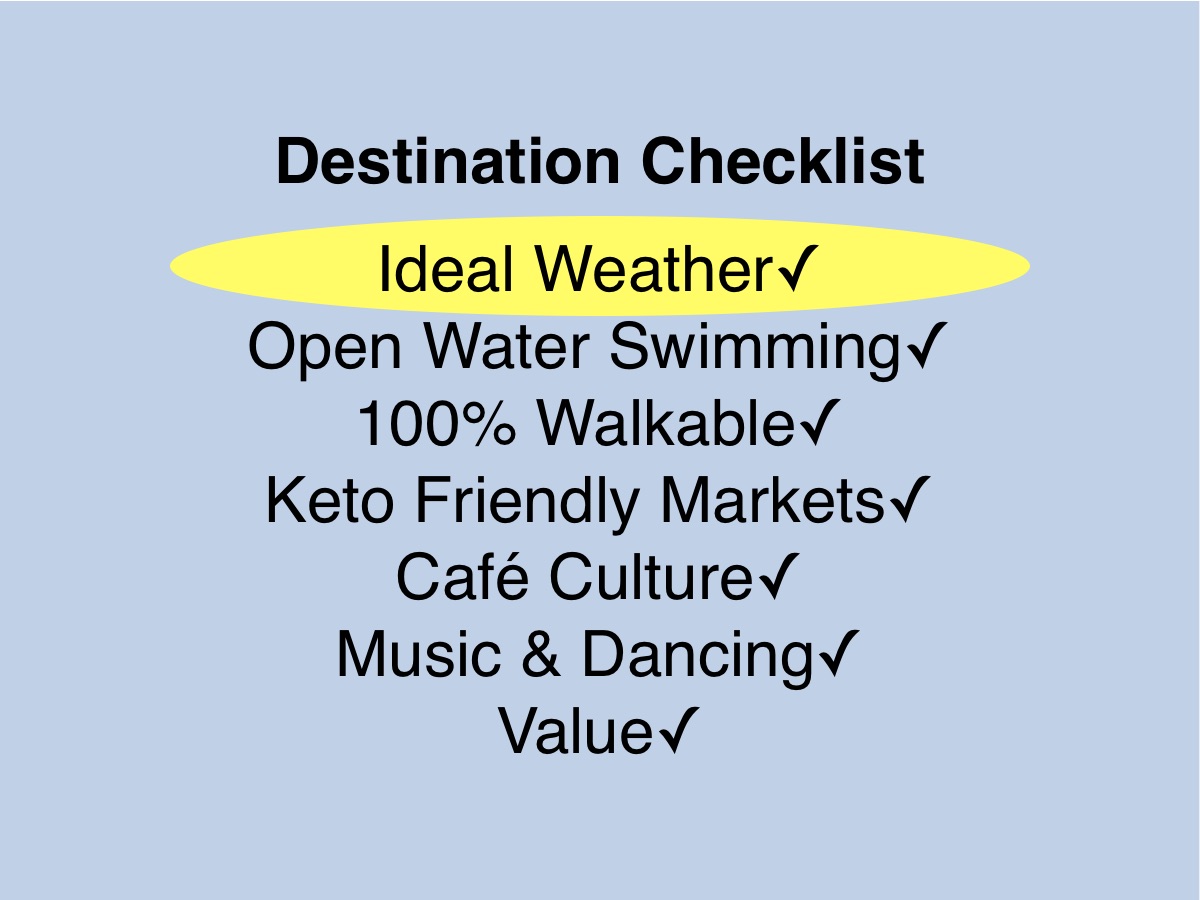
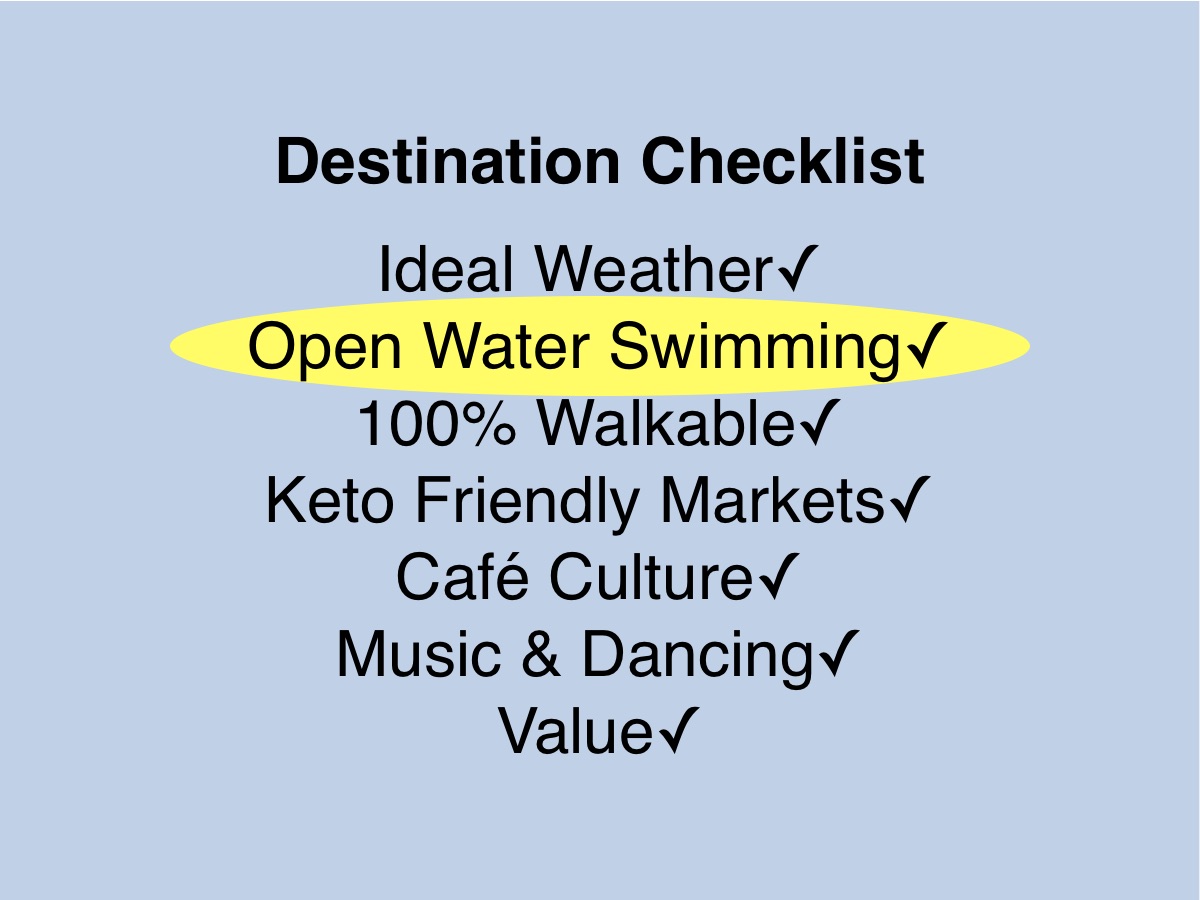
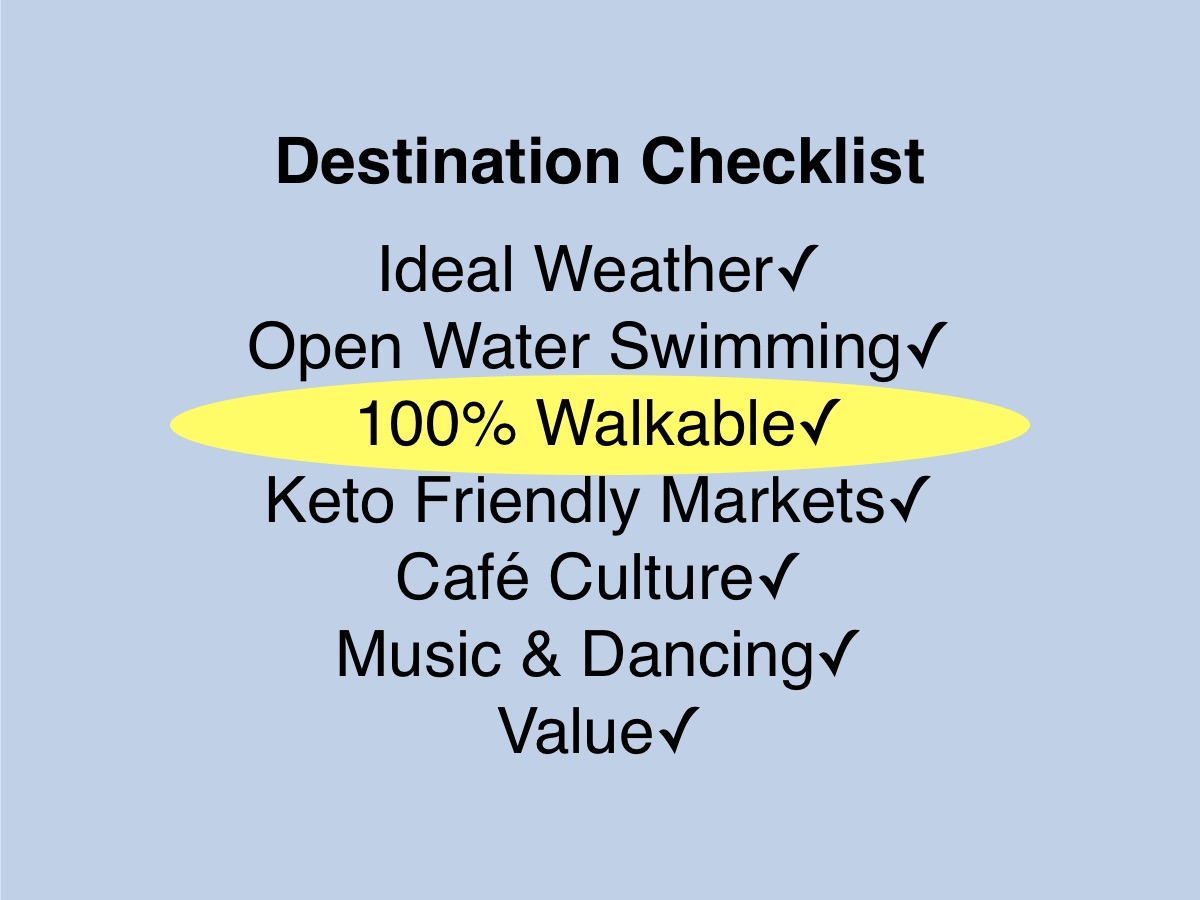
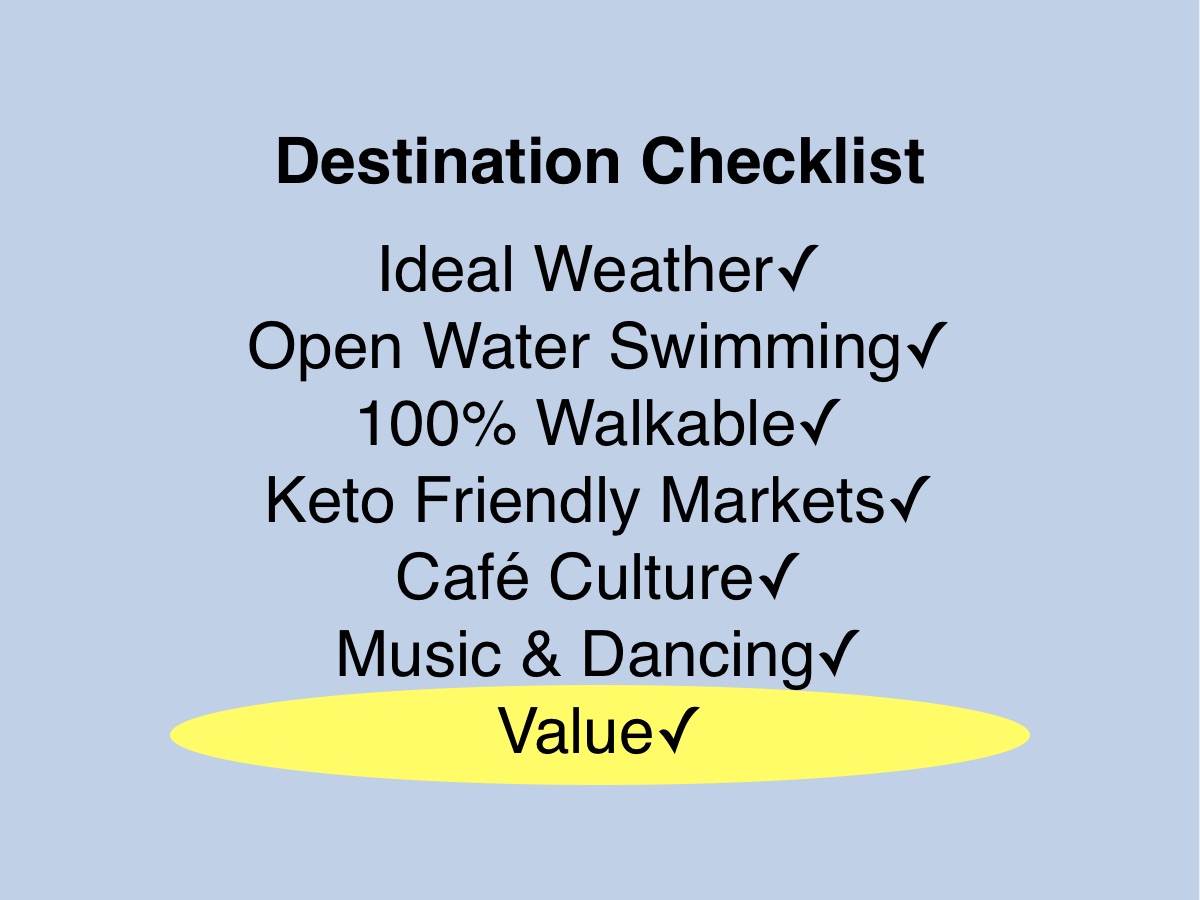
    Slow Travel Destinations must score high on all seven categories of my Destination Checklist.

    • Ideal Weather ✓
    • Open Water Swimming ✓
    • 100% Walkable ✓
    • Keto Friendly Markets ✓
    • Café Culture ✓
    • Music & Dancing ✓
    • Value ✓

    Low Score Destinations

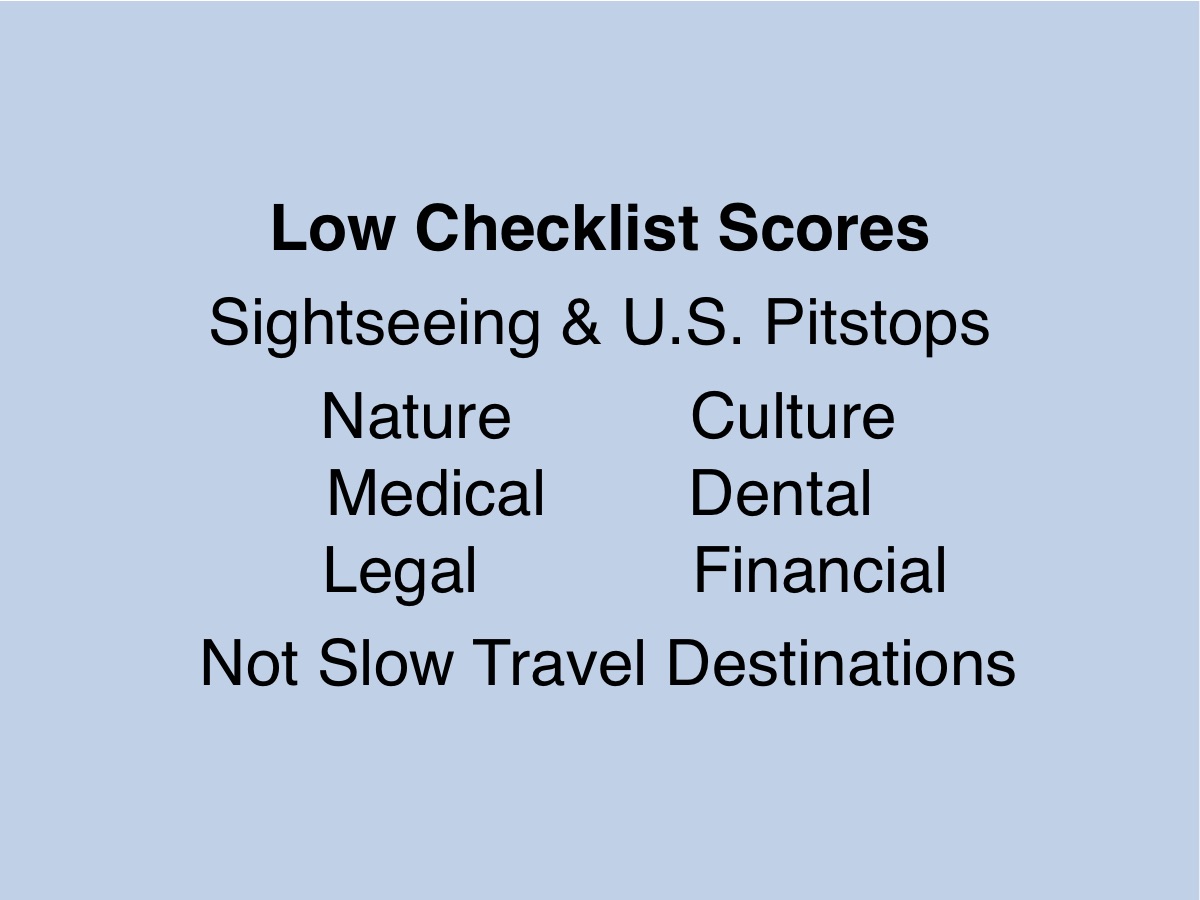
    I sometimes go to places with low Checklist scores but not for slow travel.  These trips are either short sightseeing excursions to natural and cultural wonders or pitstops in the United States for medical, dental, legal and financial reasons. High Checklist scores are absolute requirements for all of my slow travel destinations.

    Not On Checklist

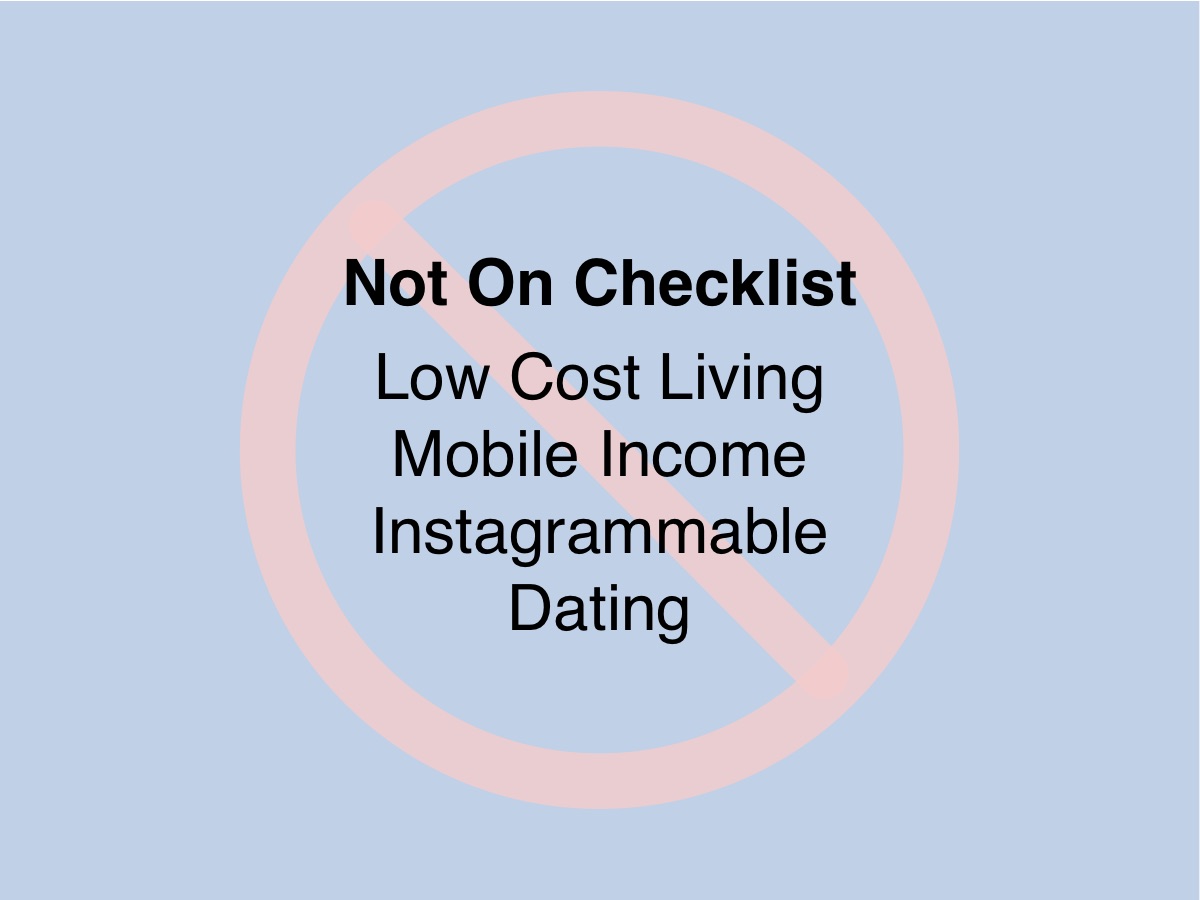
    Noticeably absent from the Checklist are things I have no interest in, need for or experience with.

    • Low Cost living
    • Mobile Income
    • Instagrammable
    • Passport Bro Dating

    Value ≠ Low Cost Living

    You may be disappointed that low cost living is not on my Checklist.  Locations that meet my requirements are among the most desirable, not cheapest, places in the world to live.

    Value is on my Checklist because destinations may score well in all other six categories but have more or less Value depending on how expensive they are.

    Value = Quality ➗ Cost

    There are place in the United States that score high in all Checklist categories except Value. For examples, South Beach Miami and Honolulu’s Ala Moana neighborhood score well in all Checklist categories except Value because they are crazy expensive. I am unaware of any place in the United States with high scores in all seven Checklist categories. There are many places outside of the United States that score high in all Checklist categories including Value because they cost much less than U.S. destinations.

    See my Destination Value post for a quick and easy way to determine relative values of slow travel destinations.

    My Destination Checklist is a vital part of a slow travel lifestyle that works well for me in my late seventies. I am confident it will continue working well into the future.

    See my other posts for in-depth explanations of all seven categories on my Destination Checklist.

    Please submit questions, comments and suggestions about slow travel and nomad living beyond 70.

  • Ideal Weather Destinations

    Ideal Weather Destinations

    Ideal Weather

    This post is about choosing slow travel destinations with Ideal Weather, the first category on my Destination Checklist.

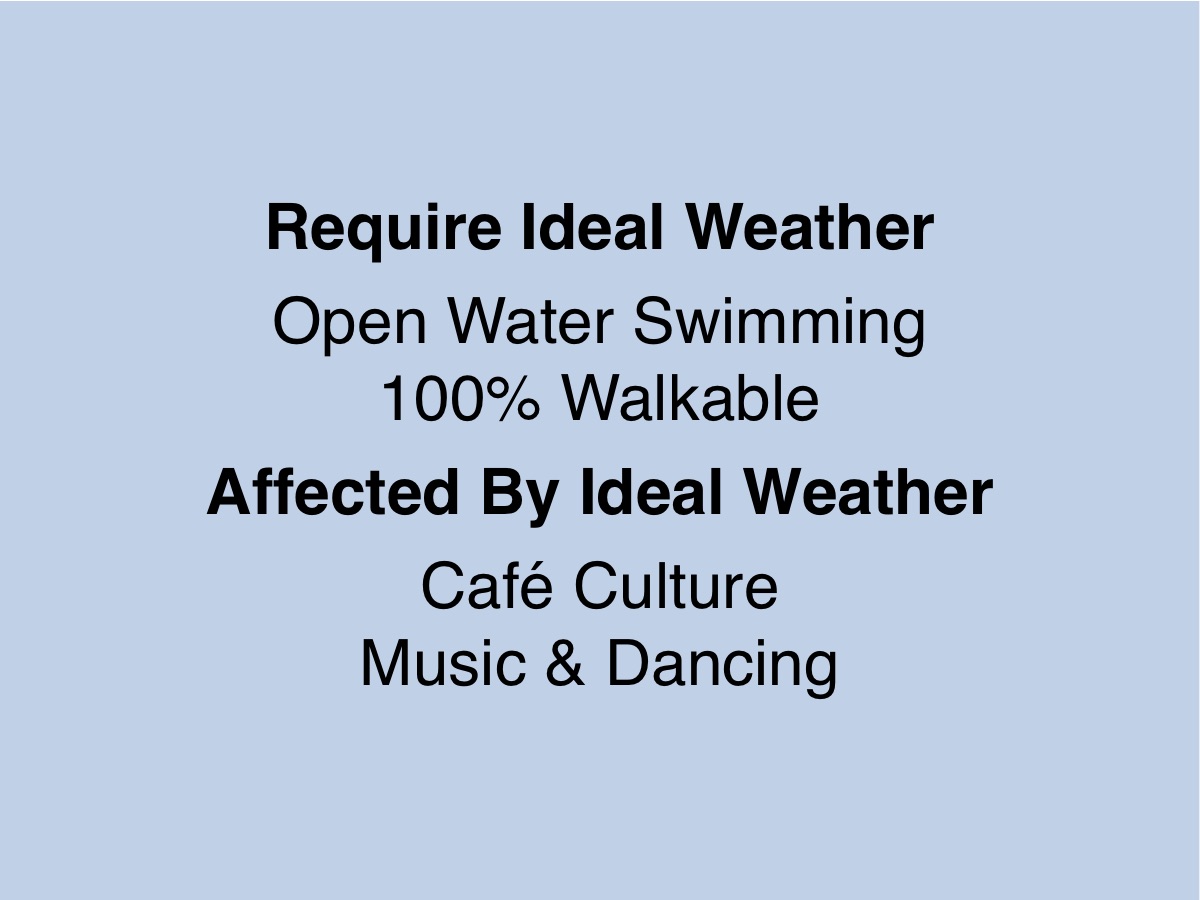
    Other Checklist Categories Affected By Weather

    • Require Ideal Weather
      • Open Water Swimming
      • 100% Walkable
    • Affected By Weather
      • Café Culture
      • Music & Dance

    Open Water Swimming Weather

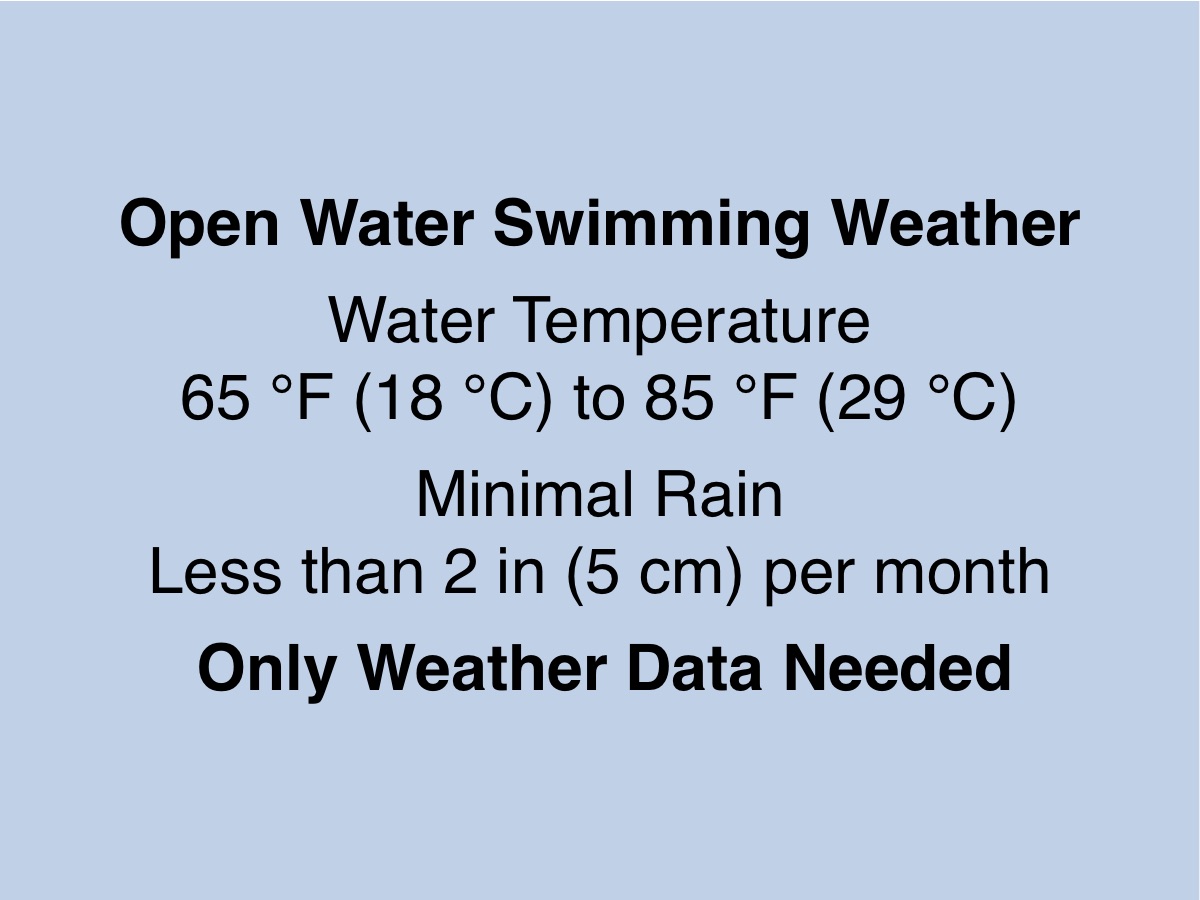
    Open Water Swimming Weather data are the only weather data need to choose slow travel destinations because they are the most restrictive weather requirements of all categories on the Destination Checklist.

    • Water Temperature
      • 65 °F (18 °C) to 85 °F (29 °C).
    • Minimal Rainfall
      • Less than 2 in (5 cm) per month.
    • Only Weather Data Needed

    Onshore and offshore weather conditions of large bodies of water are highly correlated. Destinations with suitable offshore swimming weather will invariably have ideal onshore weather for walking and outdoor café culture, music and dancing. Water temperature and rainfall are the only data needed to determine if and when locations have ideal weather.

    Weatherspark.com

    Water temperature and rainfall are the only weather data needed to choose slow travel destinations.

    Weatherspark.com is where to find these data.

    Weatherspark Data For Slow Travel Destinations

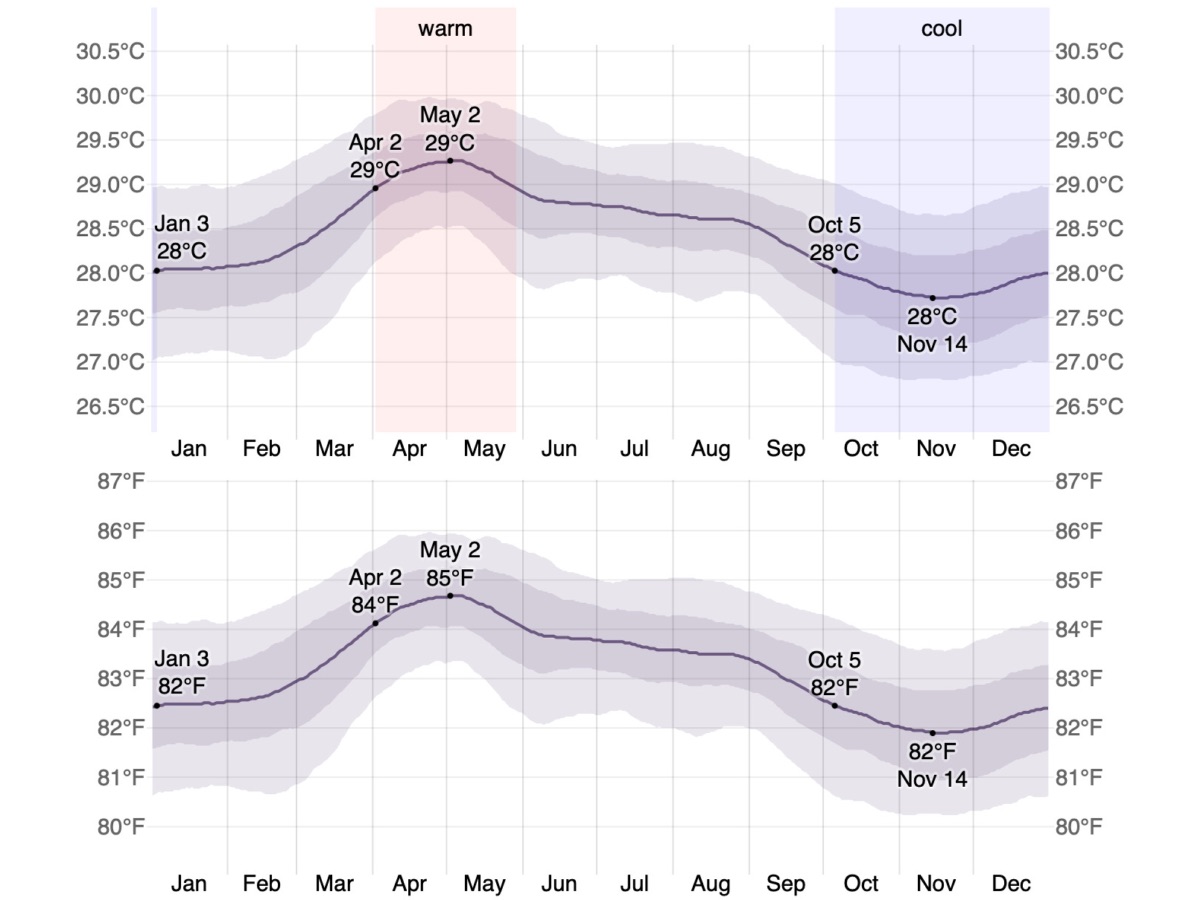
    These are Weatherspark data for two slow travel destinations: Sámara, Costa Rica and Makarska, Croatia.

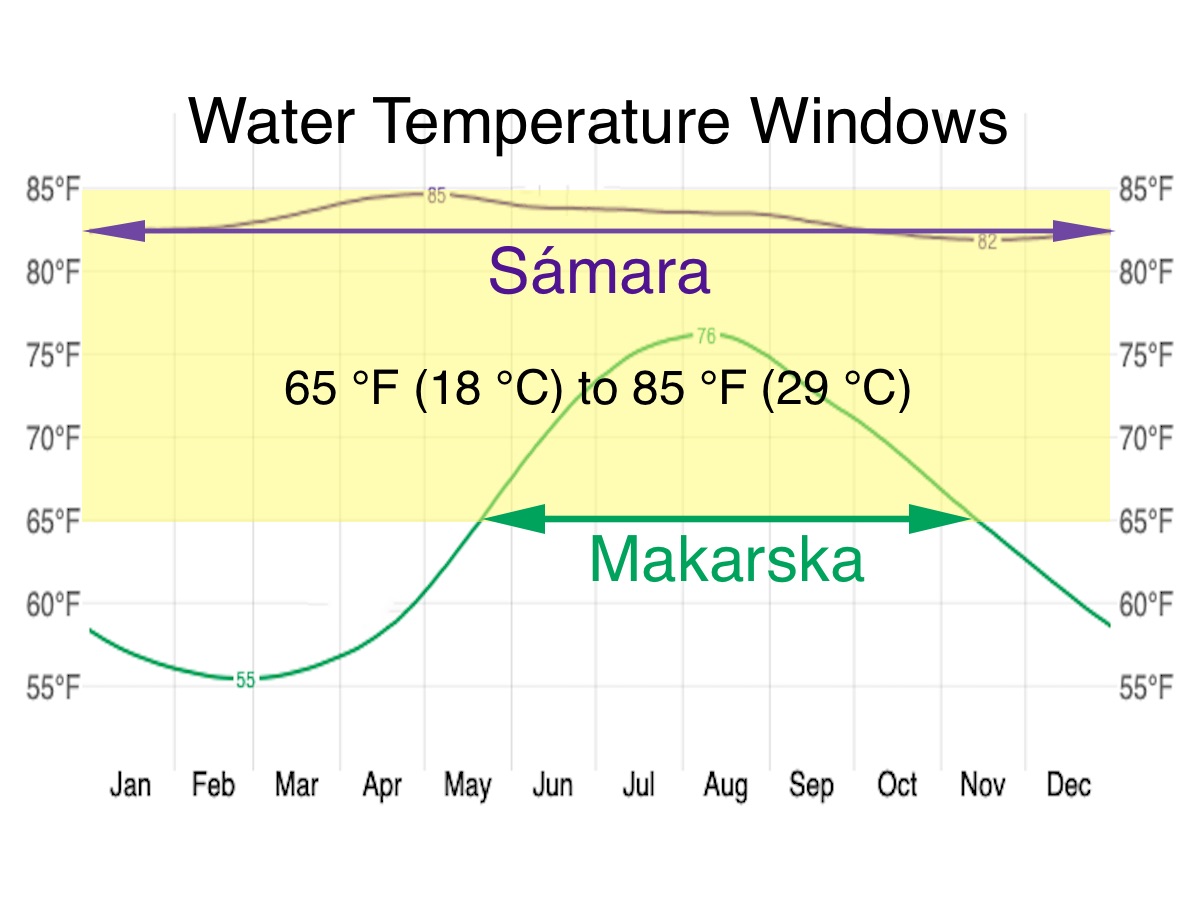
    Water Temperature Windows

    Sámara’s water temperature is swimmable all year but Makarska’s water temperature window is late May to early November.

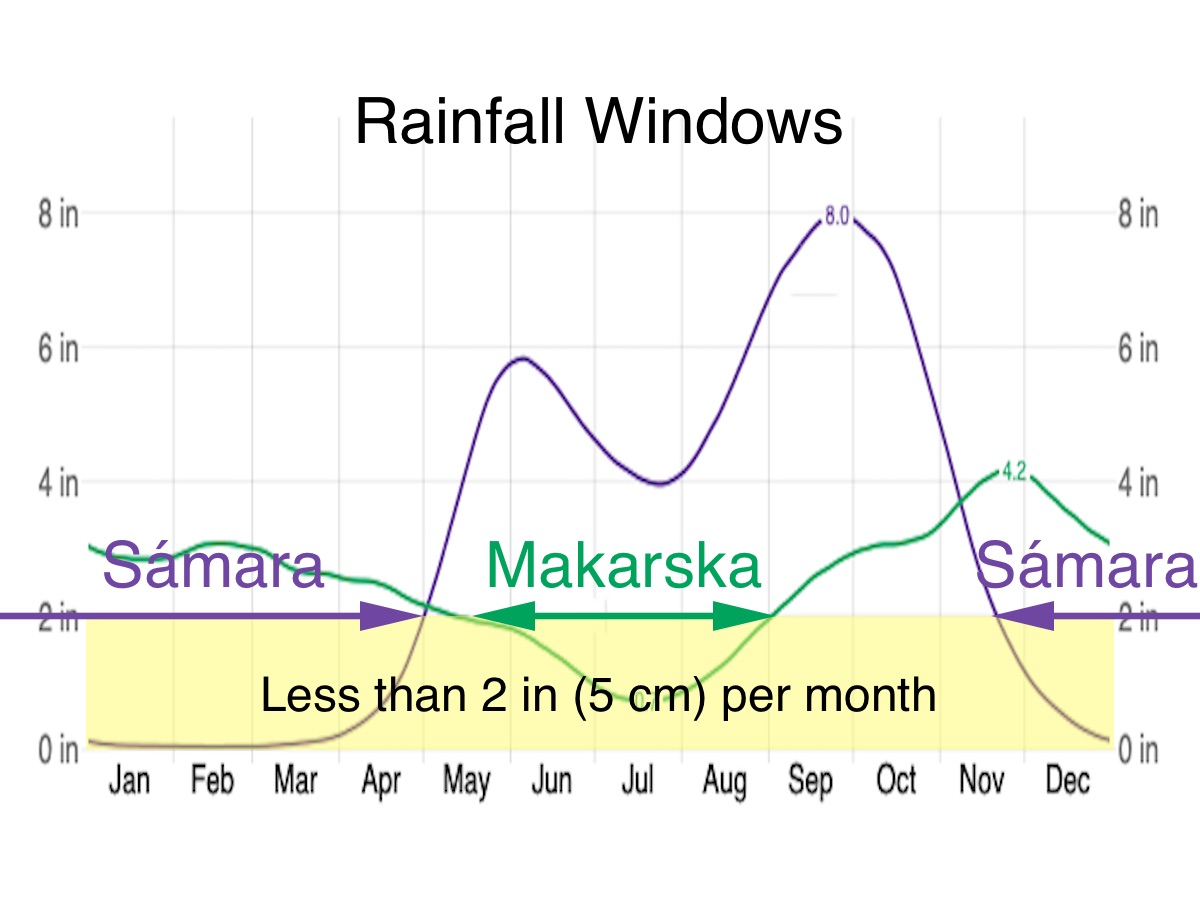
    Rainfall Windows

    Sàmara’s rainfall window is more restrictive than its water temperature window.  Sámara has minimal rainfall from late November through April.  Makarska’s rainfall window is mid-May through August.

    Ideal Weather Windows

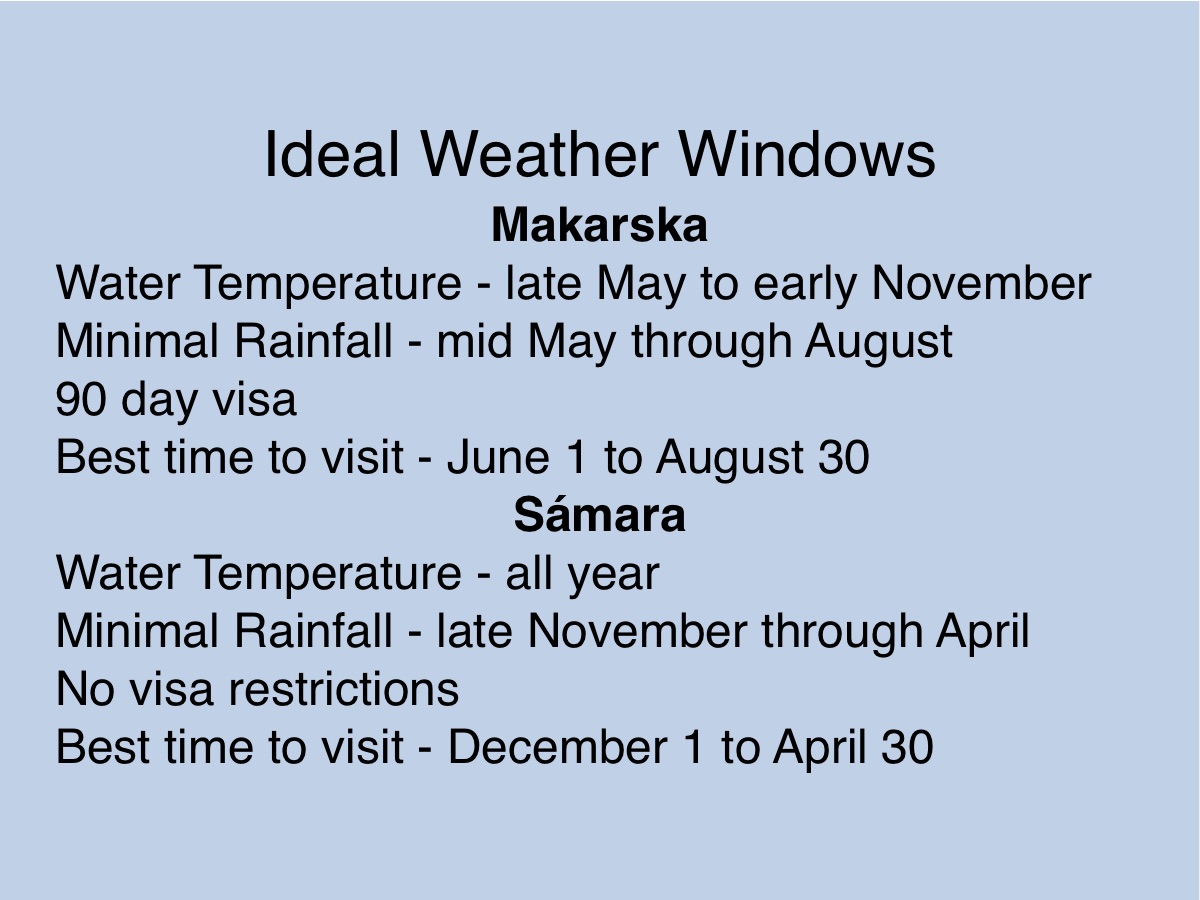
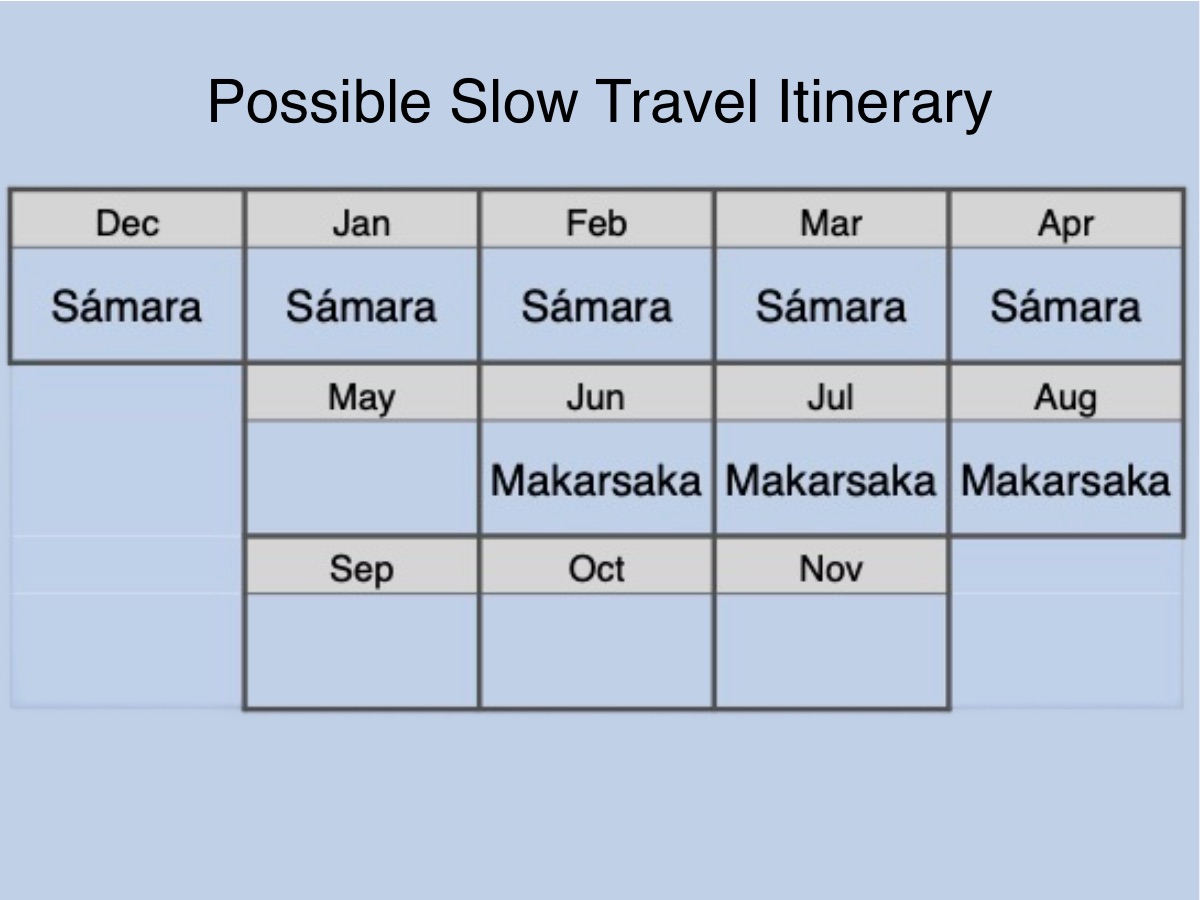
    Sámara and Makarska’s Ideal Weather windows are on opposite ends of the calendar. Croatia is a Schengen zone country that grants tourist visas for 90 of every 180 days. The best 90 days for Makarska would be from around the first of June to near the end of August.  Costa Rica’s 180-day tourist visa is indefinitely renewal with border runs.  There are no visa limitations to visiting Sámara during its five months of Ideal Weather between late November through April.

    Makarsaka

    • Water Temperature – late May to early November
    • Minimal Rainfall – mid May through August
    • 90-day visa
    • Best time to visit – June 1 to August 30 

    Sámara

    • Water Temperature – all year
    • Minimal Rainfall – late November through April
    • No visa restrictions
    • Best time to visit – December 1 to April 30 

    Possible Slow Travel Itinerary

    Slow travel to just two destinations, Sámara and Makarska, results in eight months per year of Ideal Weather.  The other four months can be filled with other ideal weather destinations, sightseeing and adventure excursions or U.S. pitstops for medical, dental, legal and financial reasons.

    Ideal Weather is a vital part of a slow travel lifestyle that works well for me in my late seventies.  I am confident it will continue working well into the future.

    In other posts, I present in-depth explanations of the other six categories on my destination checklist.

    Please submit questions, comments and suggestions about slow travel and nomad living beyond 70.

  • Open Water Swimming Destinations

    Open Water Swimming Destinations

    This post is about choosing slow travel destinations with good Open Water Swimming.

    Open Water Swimming is the most restrictive category on my Destination Checklist.

    Open Water Swimming Requirements

    • Ideal Weather
    • 100% Walkable
    • Natural Features
    • Human Activities

    No Go For Open Water Swimming

    • Not Ideal Weather
      • Water Temperature
        • Less than 65 °F (18 °C)
        • Greater than 85 °F (29 °C)
      • Rainfall
        • More than 2 in (5 cm) per month
    • Not 100% Walkable

    Water Temperature limits are my comfort zone for swimming. Water Temperature, Rainfall and 100% Walkable are easily to research (see Ideal Weather and 100% Walkable posts).

    Rain Is Bad For Open Water Swimming

    • Natural Rainwater Runoff
      • mud & debris
      • human effluent
    • Human Rainwater Drainage 
      • mud & debris
      • sewage & trash
      • industrial & agricultural waste
      • motorway grime

    Low rainfall is an absolute requirement for slow travel not because swimming in the rain is necessarily unpleasant or dangerous per se.  It is because rainwater runoff from the land flushes natural mud and debris along with raw sewage, trash, motorway grime, industrial and agricultural waste directly into swimming areas.  This is especially true in developing countries that have inadequate infrastructures for sewage treatment, trash removal, storm sewers and drainage to handle runoff from the land. Rainwater runoff is a routine and ignored fact of life in developing countries.

    Some of the world’s finest swimming beaches found in highly developed countries also have problems related to rainfall.  For example, Honolulu’s beaches are closed to the public during rare periods of extreme rainfall that overwhelm waste treatment and drainage infrastructure. It is not worth the risk to ever slow travel anywhere during rainy seasons.

    Excessive Rainfall is easily to lookup and avoid (see Ideal Weather post).

    Natural Features Bad For Swimming

    • Rainwater Runoff (see Rain above)
    • Estuaries, Swamps & Lagoons
      • shallow, strong currents
      • trap trash, pollution & runoff
    • Unsafe Entry & Exit Points
    • High Surf, Chop & Rip Currents
    • Seaweed
    • Dangerous & Unpleasant Sea-Life

    Determining Natural Features and Human Activities bad for Open Water Swimming is more difficult than looking up Ideal Weather conditions and determining 100% Walkability.

    Natural rainwater runoff is an obvious and easily problem to avoid.  Reasons may not be as obvious for avoiding other natural features.  An example is Mauritius’ well known Flic ’en Flac beach.  The beach looks great but the designated swimming area is a narrow shallow channel along the shore of the lagoon behind a barrier reef.  Signs forbidding swimming outside the designated zone are enforced by coast guard patrol boats.  There are strong currents over sharp coral and sea urchin spines outside of the zone.  Flic ‘en Flac is not good for Open Water Swimming and is therefore not a place I would slow travel to.

    In other posts I discuss potential slow travel destinations with natural features that are either good or bad for Open Water Swimming.

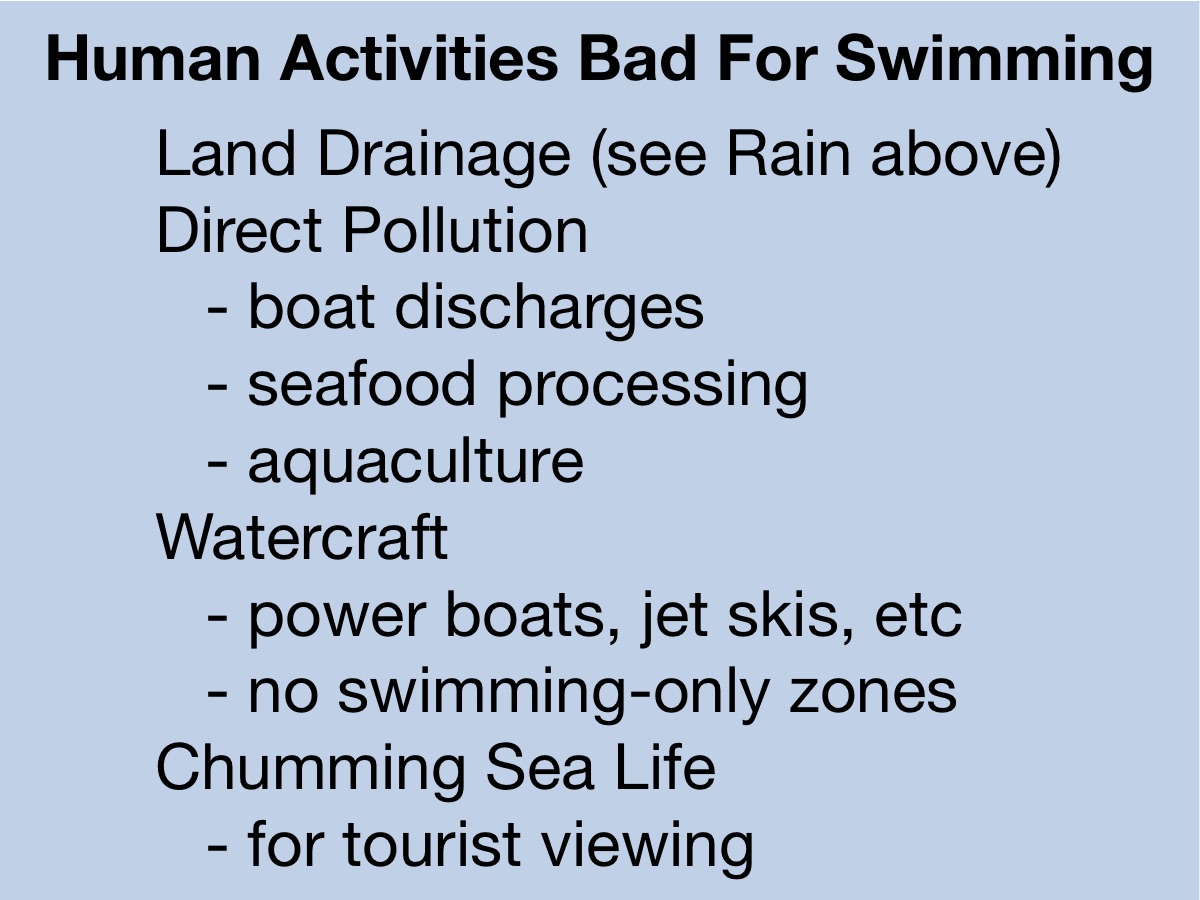
    Human Activities Bad For Swimming

    • Land Drainage (see Rain above)
    • Direct Pollution
      • boat discharges
      • seafood processing
      • aquaculture
    • Watercraft
      • power boats, jet skis, sailboards, etc 
      • no swimming-only zones
    • Chumming Sea Life
      • attracts sea life for tourist viewing

    Land drainage is an obvious and easy problem to avoid.  Reasons may not be as obvious for avoiding other human activities.  For example, local tour guides often chum patches of water with food that attracts sea-life for tourists to view.  It seems relatively harmless at first glance but it can exacerbate a natural problem.  Chummed sea-life associate humans with food and approach swimmers looking for a free lunch.  Observing sea-life while swimming can be a positive experience when the animals are going about their natural business.  It becomes unpleasant and dangerous when they see humans as a source of food and aggressively pursue, interfere with and bite swimmers.

    Please see other posts where I discuss potential slow travel destinations with human activities that are either good or bad for Open Water Swimming.

    After looking up weather and walkability, choosing slow travel destinations with good Open Water Swimming is mostly a process of eliminating places with bad natural features and/or human activities.  It takes research, a bit of guesswork and boots-on-the-ground exploring.

    A big problem in researching Open Water Swimming locations is wading through massive amounts of questionable travel information.

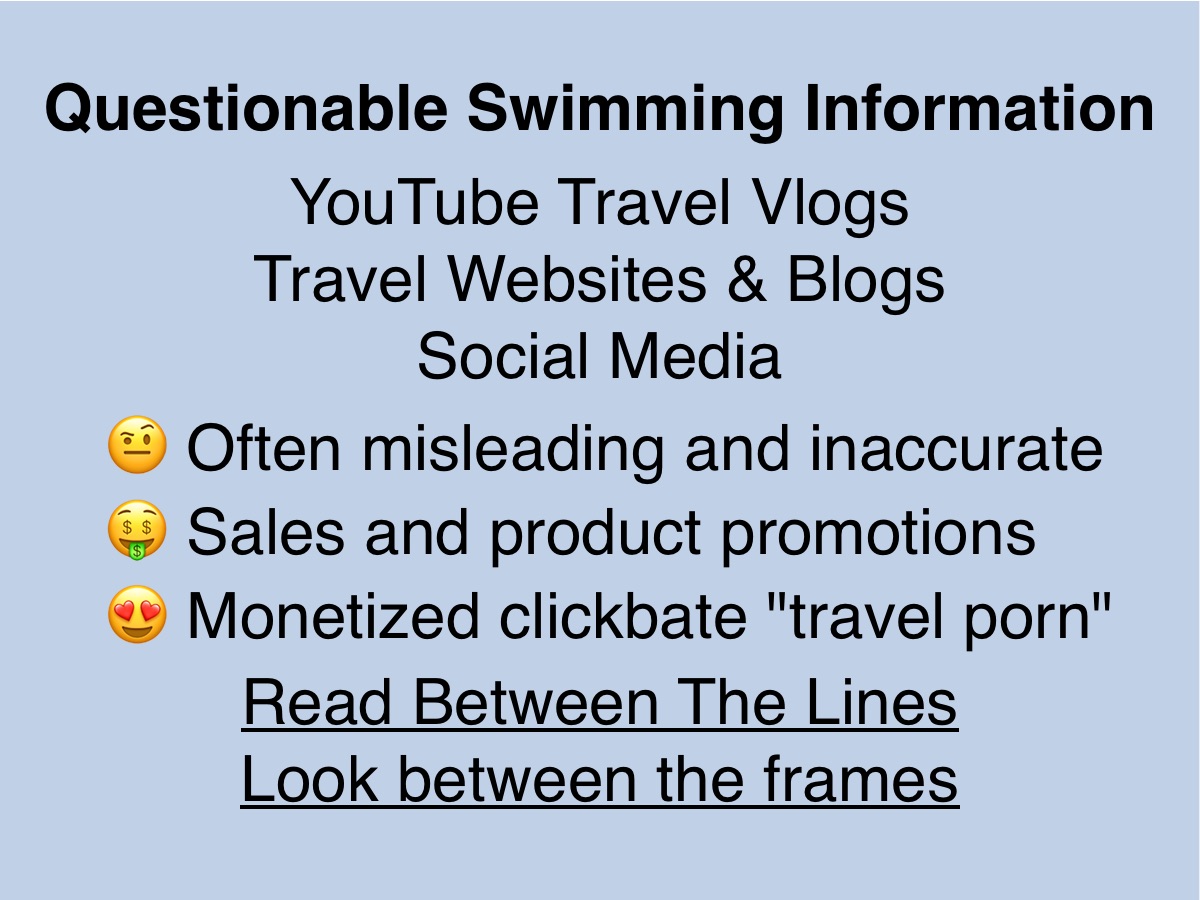
    Questionable Swimming Information

    • YouTube Travel Vlogs
    • Travel Websites & Blogs
    • Social Media
    • Misleading and inaccurate information
    • Sales pitches and product promotions
    • Monetized clickbait “travel porn”

    Always read between the lines and look between the frames of travel information. Open water swimmability is NOT necessarily indicated by video clips of beautiful beaches.  For example, Bali’s famous and photogenic Sanur Beach borders an unswimmably-shallow lagoon behind a barrier reef that fills with muddy polluted runoff every time it rains.  It is unsuitable for Open Water Swimming and therefore not a destination I am likely to slow travel to again..

    I tolerate places with questionable open water swimming for short sight seeing and exploratory excursions but not for slow travel destinations. For example, time spent on the Ganges River was a profound positive life altering experience for me.  However, I did not jump in with the Hindu pilgrimages and go for a swim with cremated human remains.  Other boots-on-the-ground Open Water Swimming experiences, good and bad, are detailed in other posts.

    Open Water Swimming is a vital part of a slow travel lifestyle that works well for me in my late seventies.  I am confident it will continue working well into the future.

    In other posts, I present in-depth explanations of the other six categories on my destination checklist.

    Please submit questions, comments and suggestions about slow travel and nomad living beyond 70.

  • 100% Walkable Destinations

    100% Walkable Destinations

    This post is about choosing 100% Walkable slow travel destinations.

    100% Walkable is one of seven categories on my Destination Checklist.

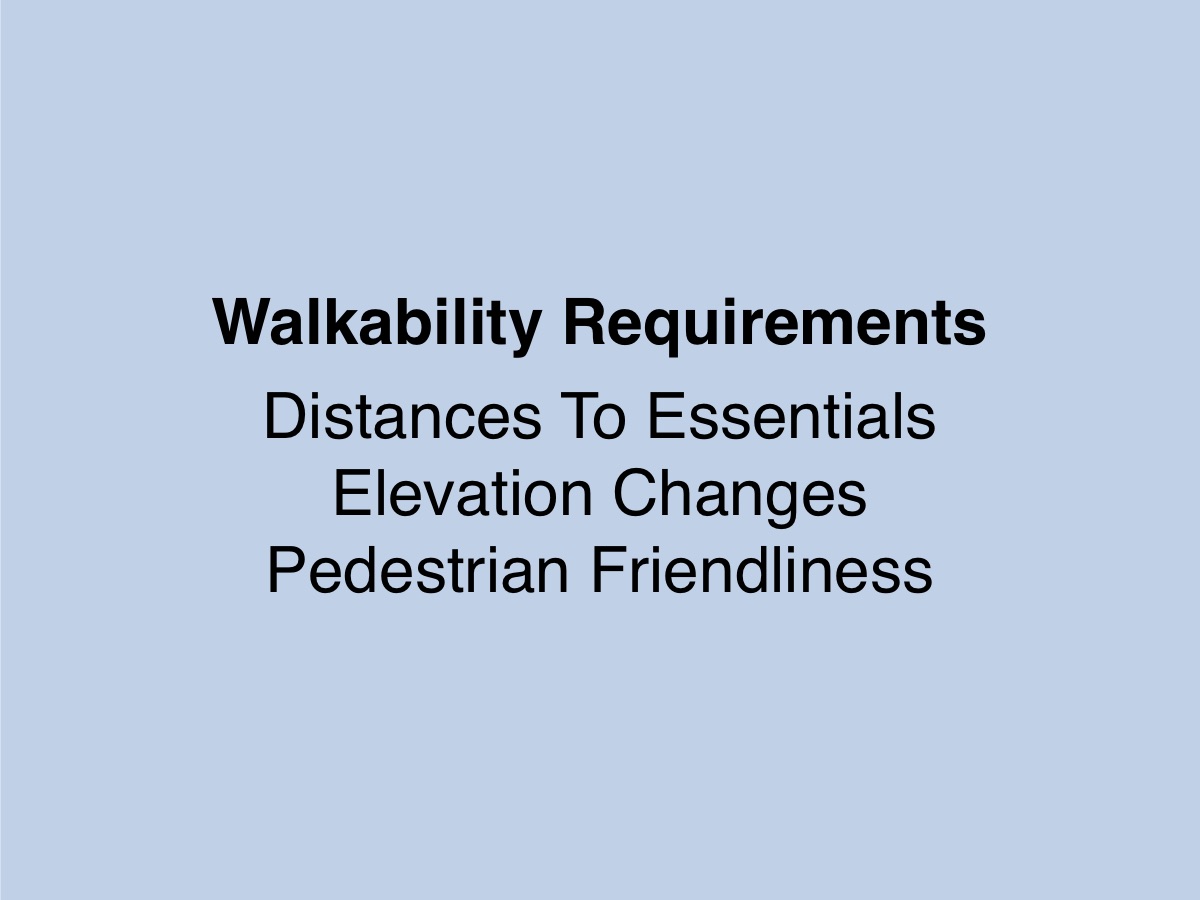
    100% Walkability Requirements

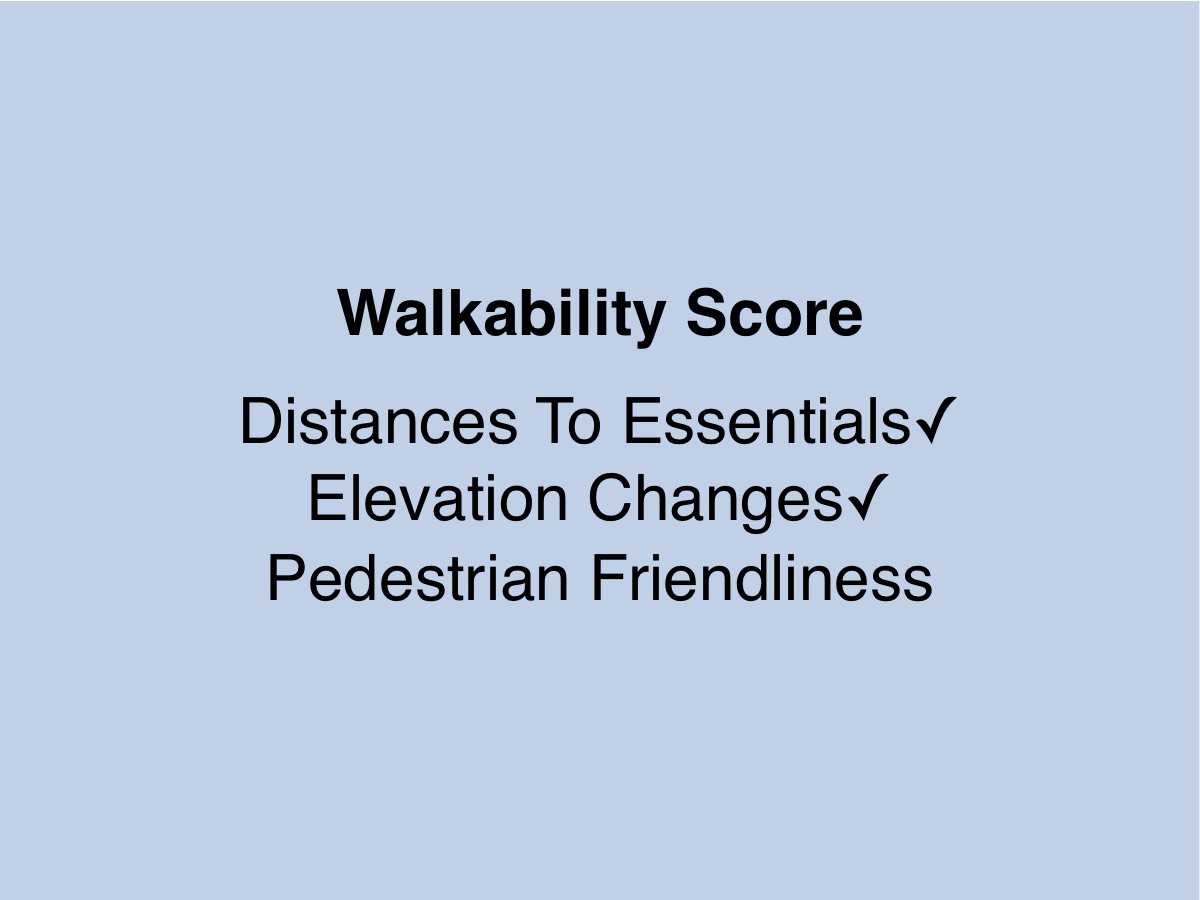
    • Distances To Essentials
    • Elevation Changes
    • Pedestrian Friendliness

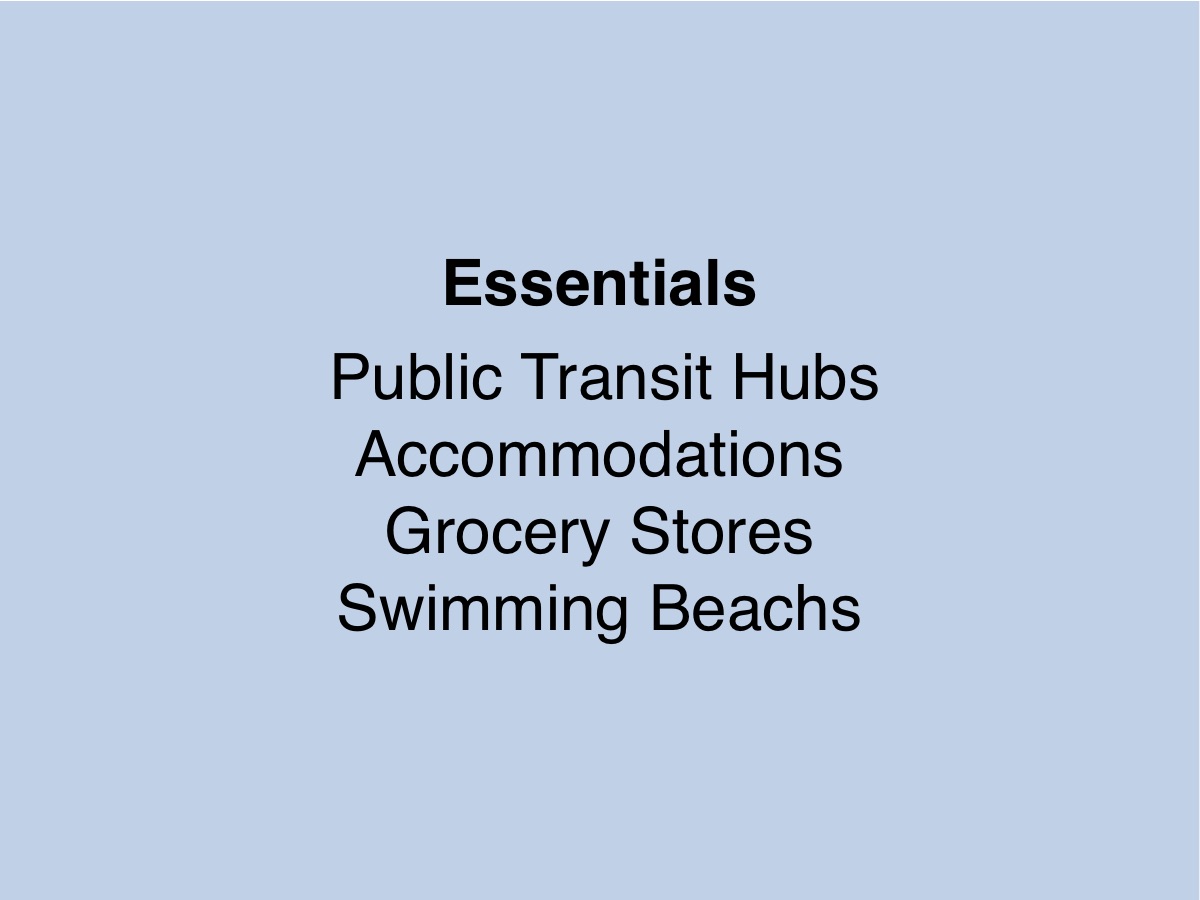
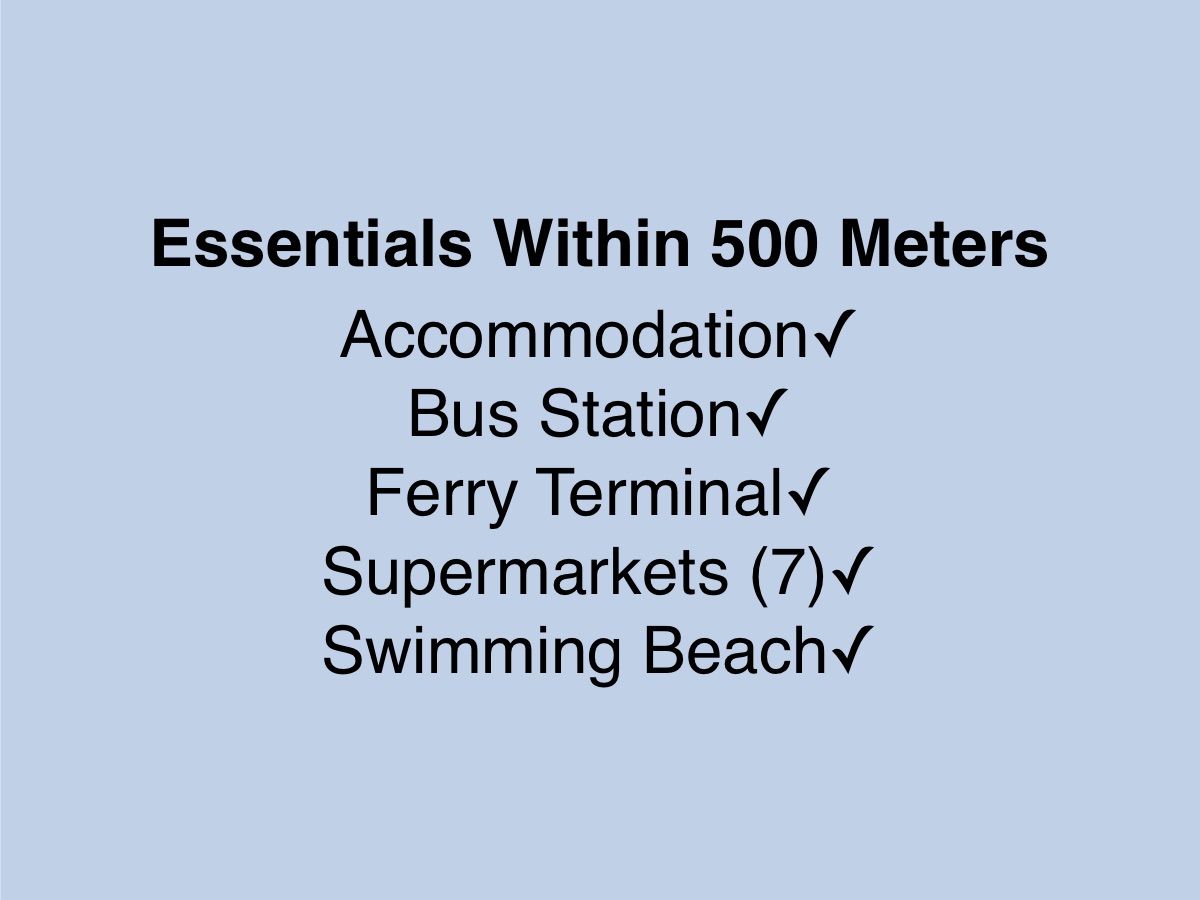
    Essentials must be within walking distance of each other.

    • Public Transit Hubs
    • Accommodations
    • Grocery Stores
    • Swimming Beaches

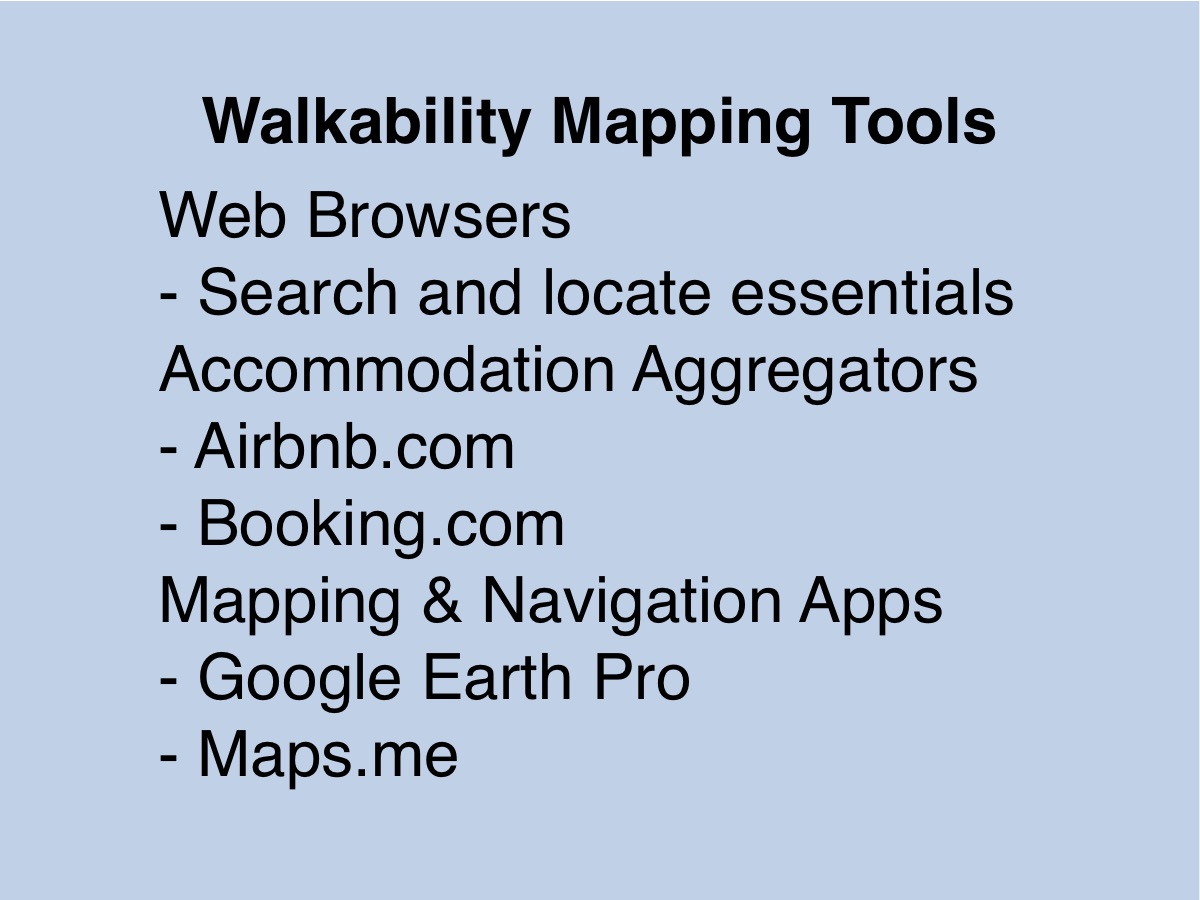
    Mapping Tools are used to locate Essentials.

    • Web Browsers
      • Search and locate essentials
    • Accommodation Aggregators
      • Airbnb.com
      • Booking.com
    • Mapping & Navigation Apps
      • Google Earth Pro
      • Maps.me

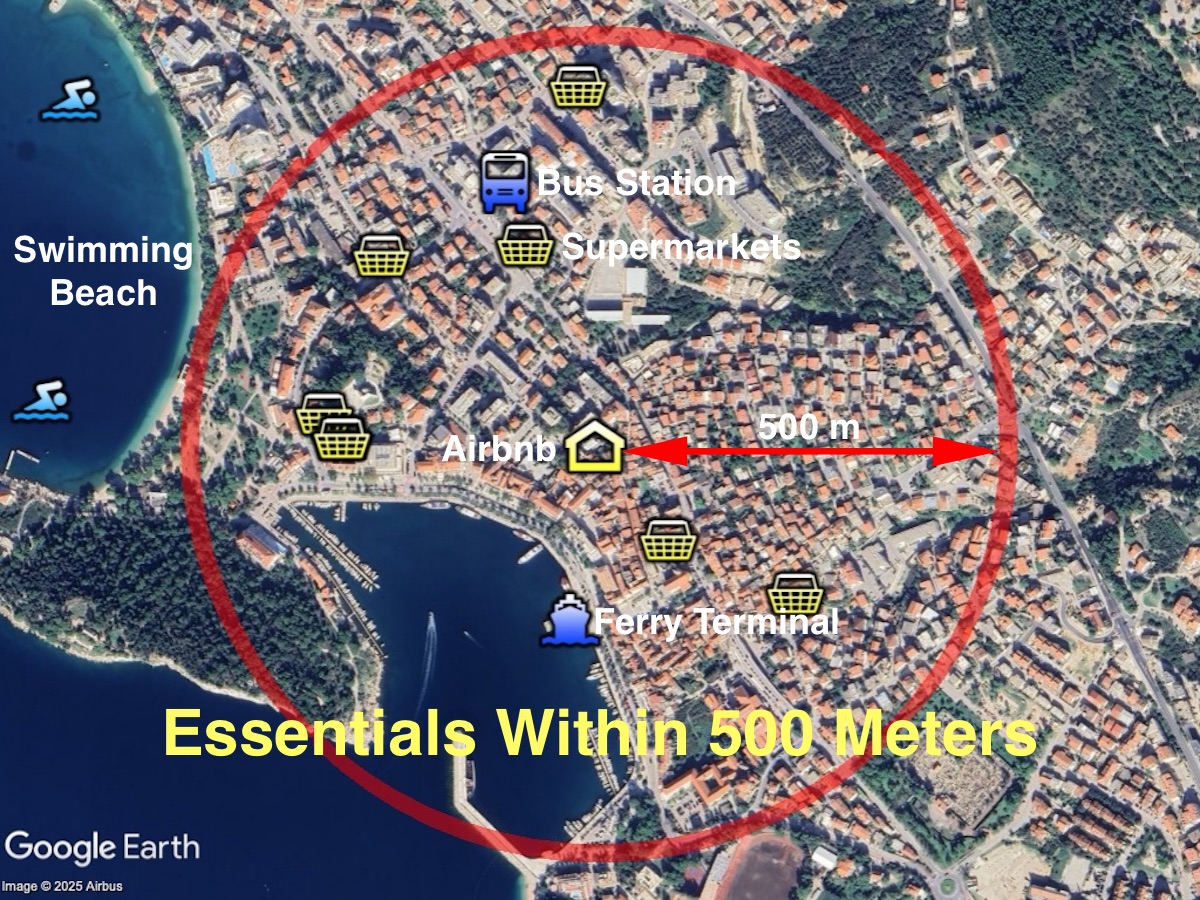
    Google Earth Pro screenshot showing Essentials within 500 meters (0.3 miles) of an accommodation in Makarska, Croatia.

    Essentials within 500 meters (0.3 miles) of an accommodation in Makarska, Croatia

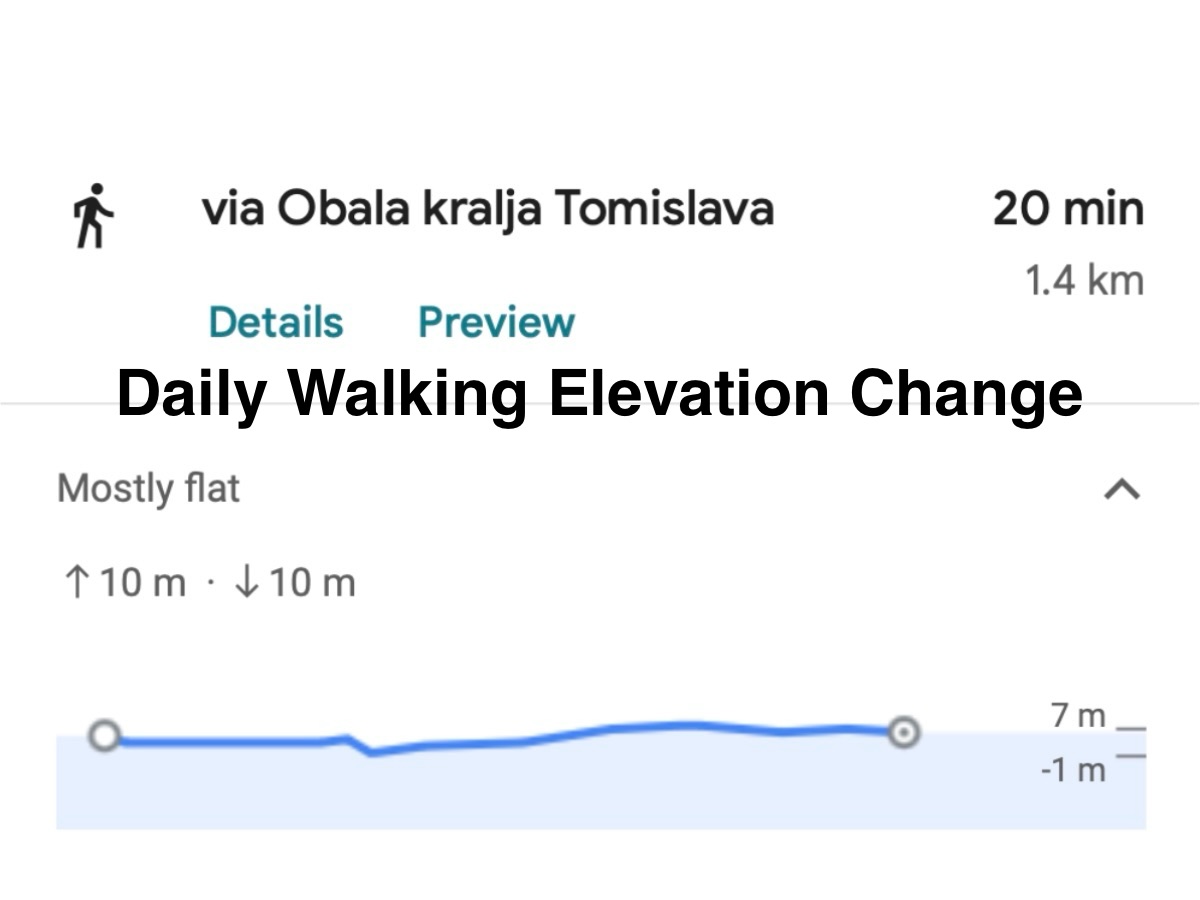
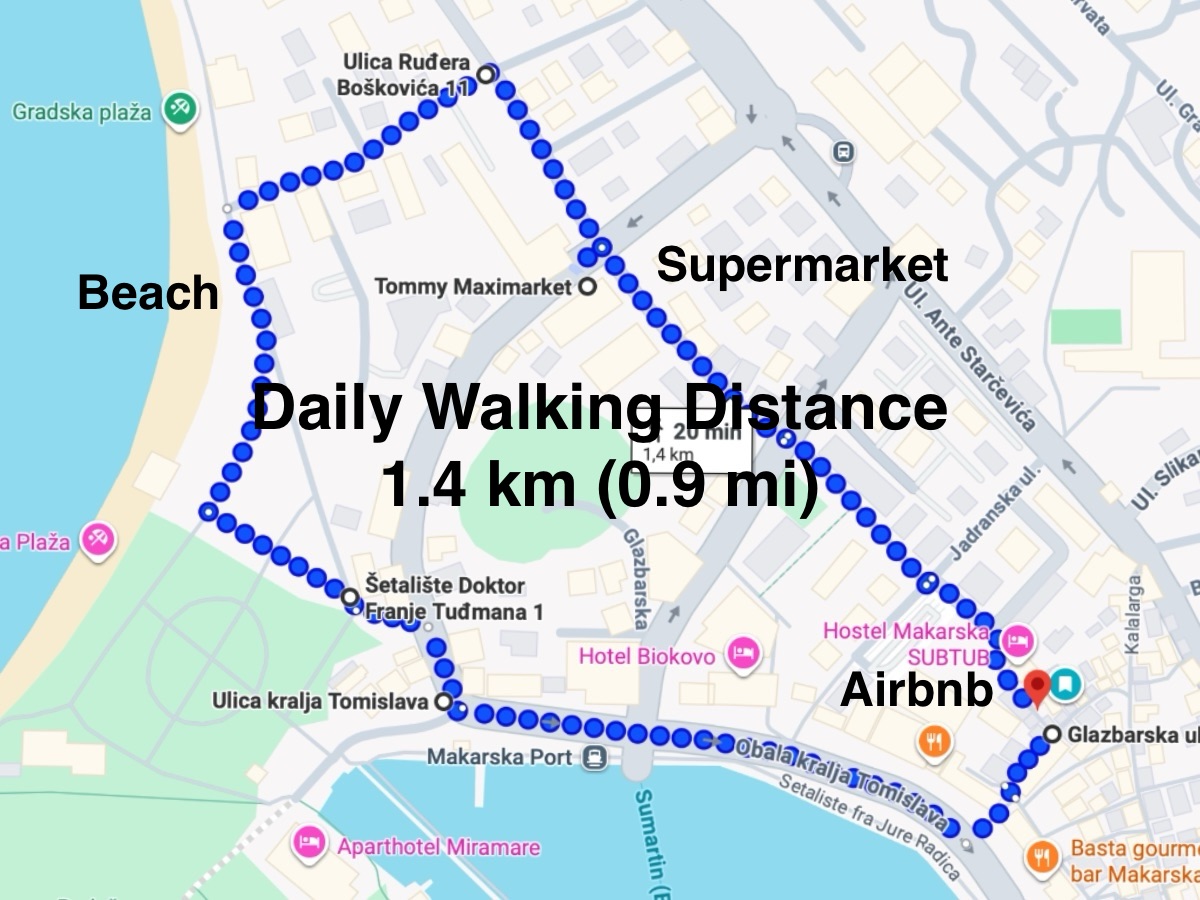
    A typical day’s walk to the beach for a swim followed by grocery shopping on the way home.  The total walking distance is 1.4 km (0.9 mi).

    Over mostly flat ground.

    Pedestrian Friendliness is not as easy to research as locating essentials on Google Maps.

    Pedestrian Friendliness

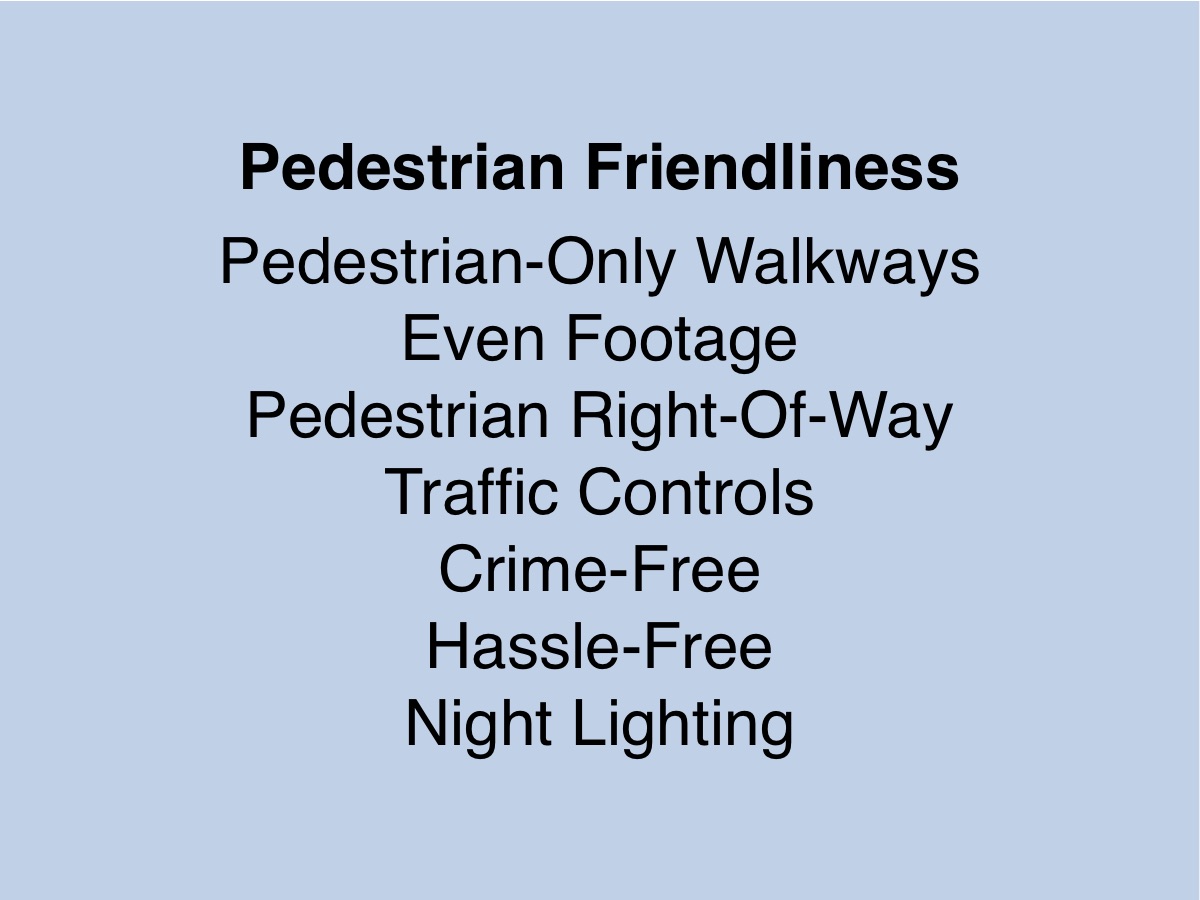
    • Pedestrian-Only Walkways
    • Even Footage
    • Pedestrian Right-Of-Way
    • Traffic Controls
    • Crime-Free
    • Hassle-Free
    • Night Lighting.

    Pedestrian Friendliness is rare in much of our auto-centric world. In the United States it is a luxury found only in a few affluent locations like Miami’s South Beach and Honolulu’s Ala Moana neighborhood.  The same is true for parts of other highly developed countries including Canada, Australia and New Zealand.

    Developing countries often have worse Pedestrian Friendliness than the highly developed countries mention above.  Developing countries prioritize motor vehicle infrastructure over potable tap water, sewage treatment and pollution control.  Sidewalks are not even on their radars.  Large western-style shopping malls don’t count as pedestrian friendly.  They may have miles of perfectly walkable interior corridors but outside is a different story. 

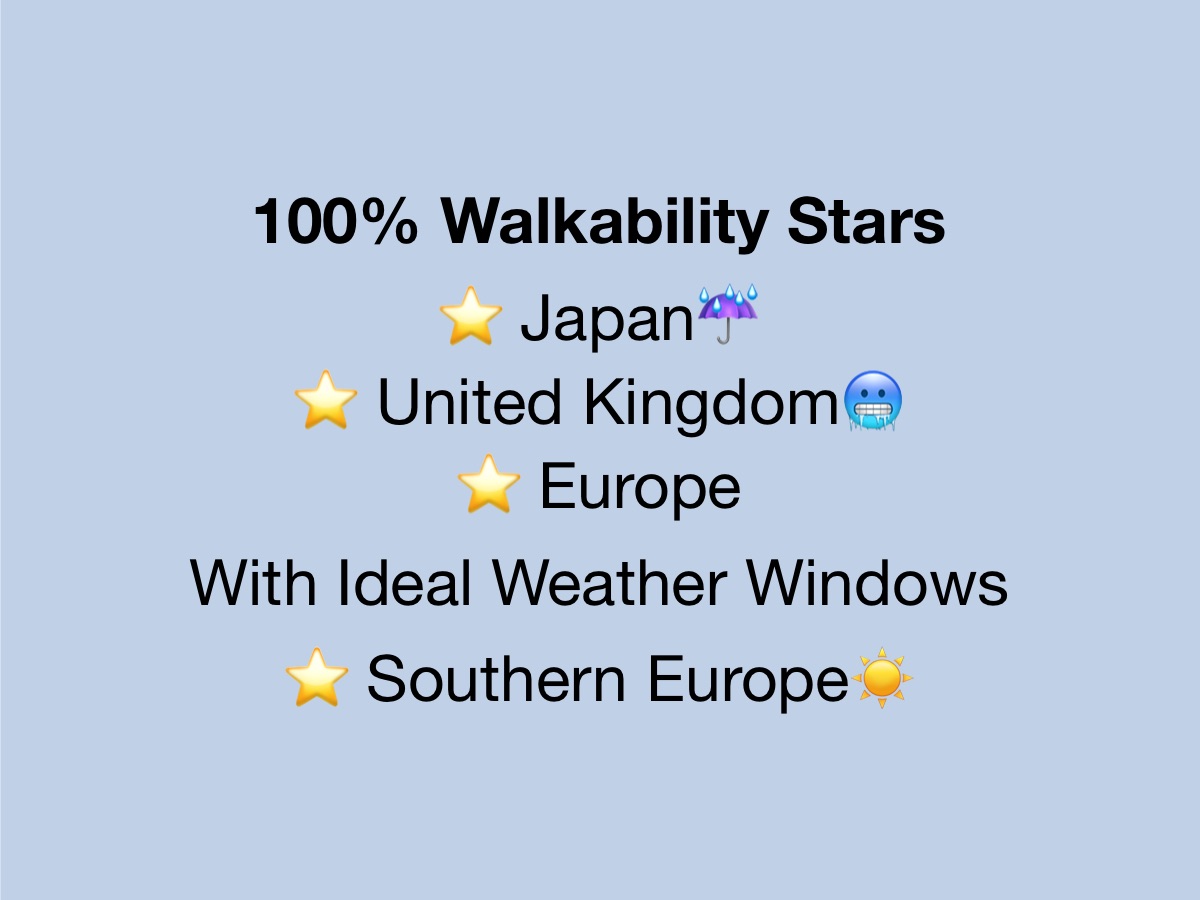
    Pedestrian Friendliness often goes hand in hand with good public transportation infrastructure. The real stars of both are Japan, United Kingdom and Europe. The only caveats are elevation changes in hilly cities like Lisbon and smooth surfaces everywhere that can be slippery when wet. Both are ruled out by two other categories on my Destination Checklist. Ideal Weather excludes rain and Open Water Swimming is done from flat shorlines. Beach towns in Japan, United Kingdom and Europe are safe bets for 100% Walkability but only Southern Europe has Ideal Weather windows June through October.

    What about Walkability at other times and places?  It takes research, a bit of guesswork and boots-on-the-ground exploring.

    A big problem in researching Walkability is wading through massive amounts of questionable travel information. The few good sources of information about Walkability are drowned in a sea of questionable information.

    Questionable Walkability Information

    • Questionable Sources
      • YouTube Travel Vlogs
      • Travel Websites and Blogs
      • Social Media
    • Questionable Information
      • Often misleading and inaccurate
      • Sales pitches and product promotions
      • Monetized clickbait “travel porn”

    You have to read between the lines and look between the frames.

    Pedestrian Friendliness is NOT indicated by video clips of walking in streets with motor traffic, driving around on motor scooters, riding in tuk tuks, mall walking and motor traffic that does not stop for pedestrians.  Pedestrian Friendlies is NOT indicated by warnings about pick pockets, aggressive street people and horror stories of sever injuries from falls caused by poor footage.

    I tolerate places with questionable Walkability for short sight seeing and exploratory excursions but not for slow travel destinations.  For example, a month spent in Rio de Janeiro for Carnaval was a profound positive life altering experience for me.  However, crime and aggressive street people diminish Rio’s Walkability score to zero and rule it out as a slow travel destination.  Rio’s crowded, dangerous and polluted beaches don’t help.

    Other boots-on-the-ground exploring have yielded different outcomes for finding 100% Walkable slow travel destinations.  Tamarindo and Sámara looked like two promising beach towns in Costa Rica.  I explored each for a month.  For me, Tamarindo is a barely walkable spring-breaker hell scape.  On the other hand, Sámara is a very walkable and pleasant slow travel destination during Costa Rica’s dry season. Other boots-on-the-ground Walkability experiences, good and bad, are detailed in other posts.

    Choosing 100% Walkable destinations is a vital part of a slow-travel lifestyle that works well for me in my late seventies.  I am confident it will continue working well into the future.

    In other posts, I present in-depth explanations of the other six categories on my destination checklist.

    Please submit questions, comments and suggestions about slow travel and nomad living beyond 70.

  • Keto Friendly Markets

    Keto Friendly Markets

    This post is about choosing slow travel destinations with Keto Friendly Markets.

    Keto Friendly Markets is one of seven categories on my Destination Checklist.

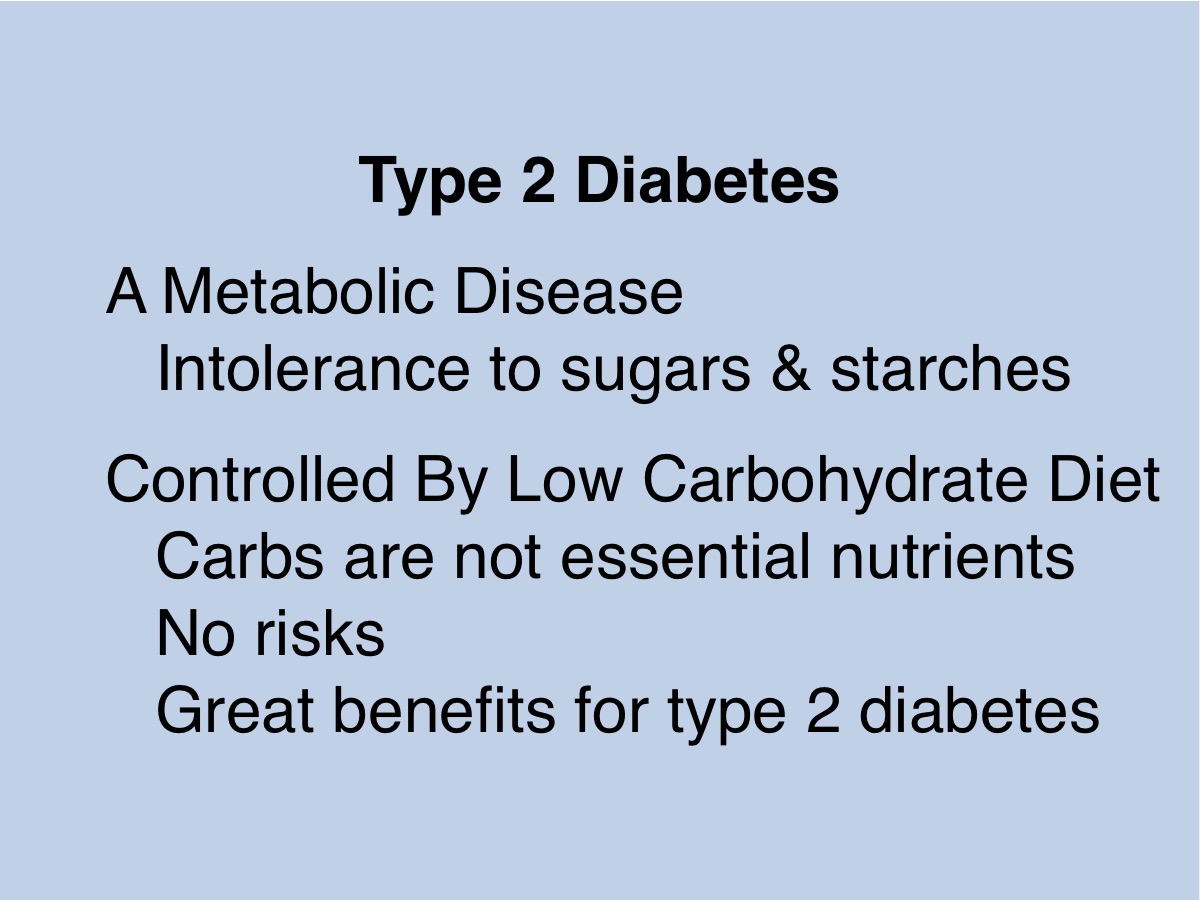
    Keto Friendly Markets became an absolute necessity at the age of 76 when I was diagnosed with type 2 diabetes.  I was miserably obese and every inch of my body was racked by debilitating inflammation. I began experimenting with a low carbohydrate and intermittent fasting diets sourced from Keto Friendly Markets.  My health rapidly improved.  

    Everyone’s health and approach to health care and diet are unique.  There are many types of dietary diseases and treatments.  I am fortunate to not suffer from alcoholism, lactose intolerance, celiac disease, nut allergies or any of the many other types of metabolic and immunologic diseases related to diet.   My body simply cannot tolerate dietary sugars and starches.  I am fortunate that there is a simple cure – not eating sugars and starches.  I am fortunate that carbohydrates are not essential nutrients.  I am fortunate there are no risks and great benefits from not eating sugars and starches just as there are no risks and great benefits to not consuming alcohol for alcoholics, gluten for celiac disease and so forth.

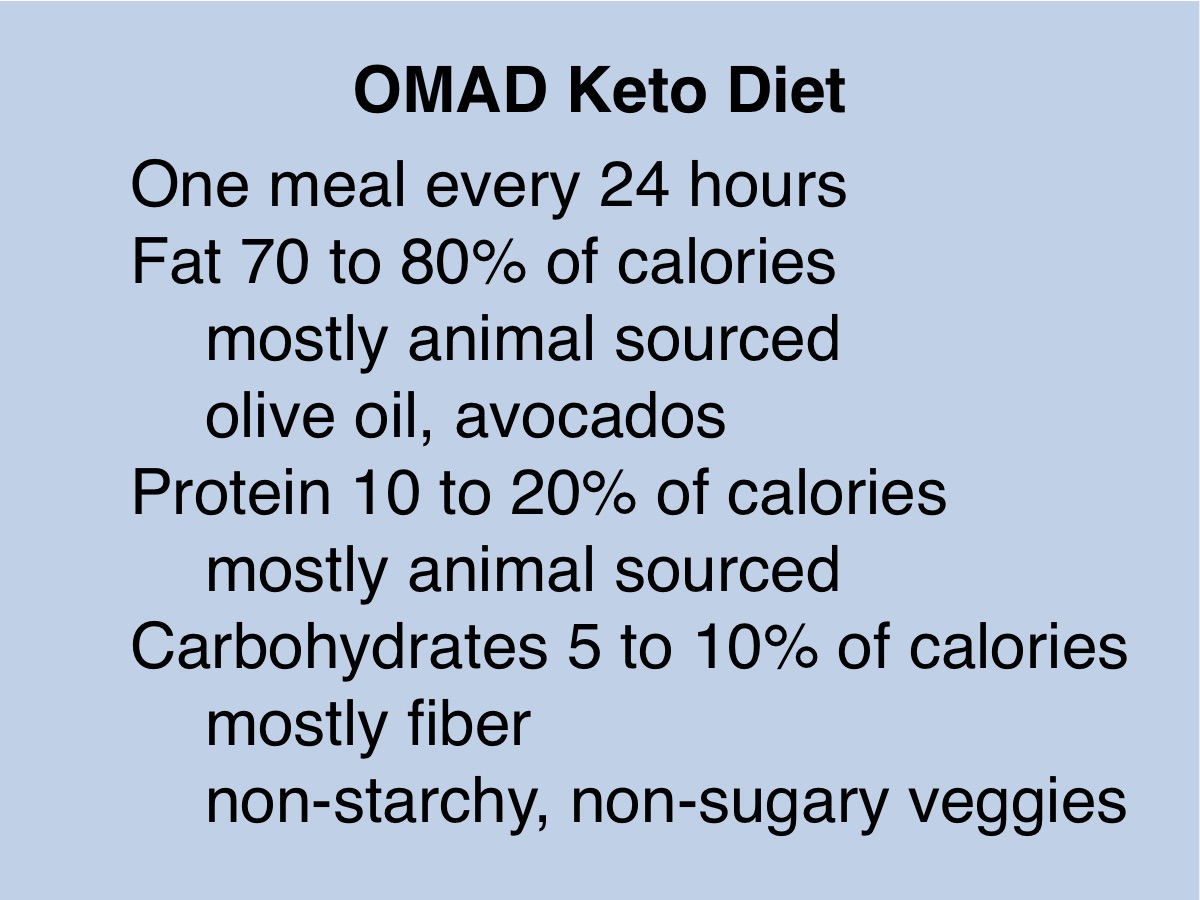
    These are many names and definitions for low carbohydrate diets and intermittent fasting.  I just say my diet is OMAD Keto.  OMAD stands for one meal a day (every 24 hours).  Keto is short for ketogenic which I define as a caloric content of 70 to 80% fat, 10 to 20% protein and 5 to 10% carbohydrates.  Most of the fat and protein are animal sourced from fish, butter, cheese, chicken (skin on), pork, beef, and eggs.  Major exceptions are fat from olive oil and avocados. Carbohydrates are mostly fiber from non-starchy and non-sugary plants like broccoli, spinach, cauliflower, cabbage, peppers, avocados and some types of nuts.

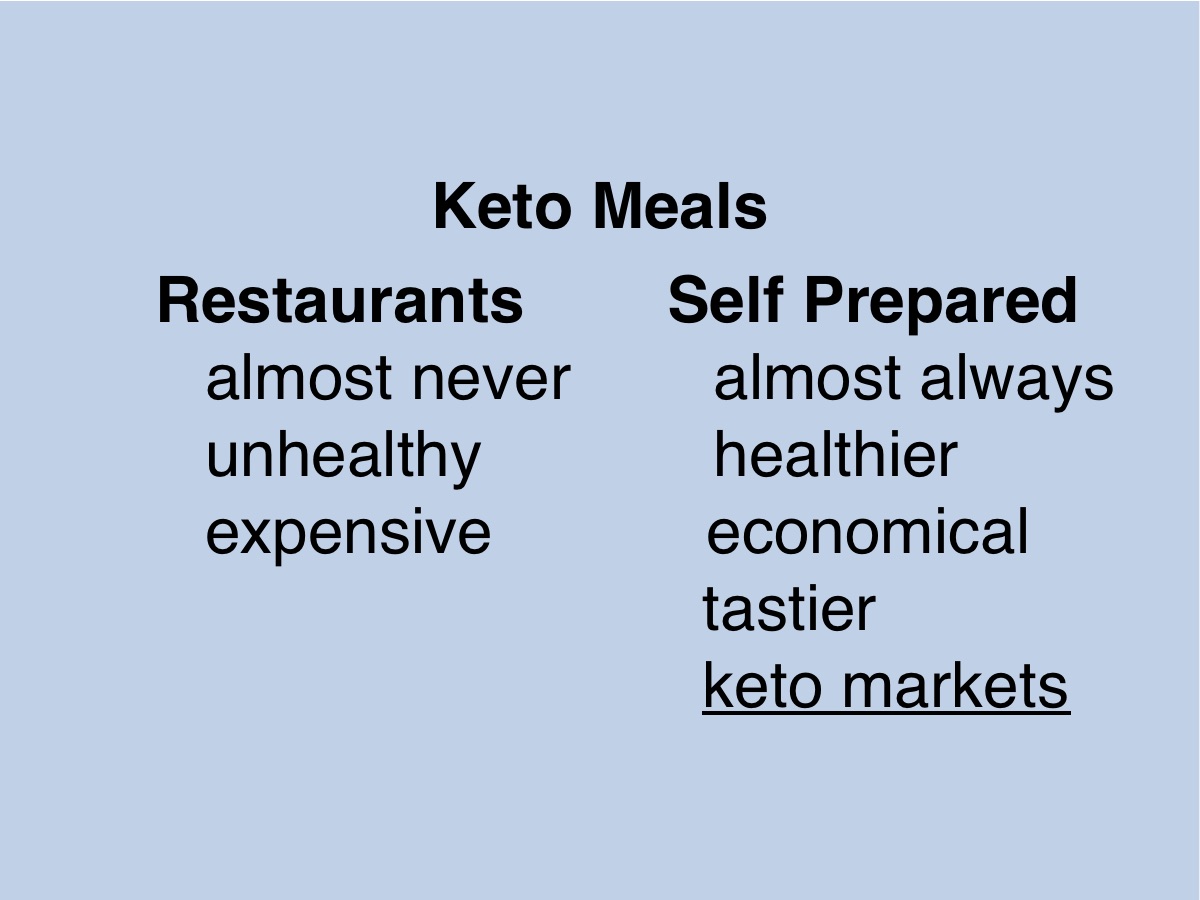
    I prepare nearly every meal and rarely eat out because I am a far better cook than most restaurants whose food is universally unhealthy and expensive.  My cooking ingredients are sourced from Keto Friendly Markets that I define as having abundant varieties of high quality animal products, olive oil and non-starchy vegetables.  I always book slow travel accommodations with adequate cooking facilities that are within easy walking distance of Keto Friendly Markets.

    My OMAD keto diet sourced from Keto Friendly Markets is a vital part of a slow travel lifestyle that works well for me in my late seventies.  I am confident it will continue working well into the future.

    In other posts, I present in-depth explanations of the other six categories on my Destination Checklist.

    Please submit questions, comments and suggestions about slow travel and nomad living beyond 70.

  • Destination Value

    Destination Value

    This post is about a quick and easy way to calculate and compare values of slow travel destinations. Value is the last category on my Destination Checklist.

    This post is about evaluation of slow travel Destination Value which is one of seven categories on my Destination Checklist.  

    Let’s agree that:

    Destination Value = Quality ➗ Cost

    The quality part of the equation is a subjective summation of all Destination Checklist categories except Value. Only destinations of similar high quality are considered for slow travel.

    Therefore: Destination Value ≈ Cost

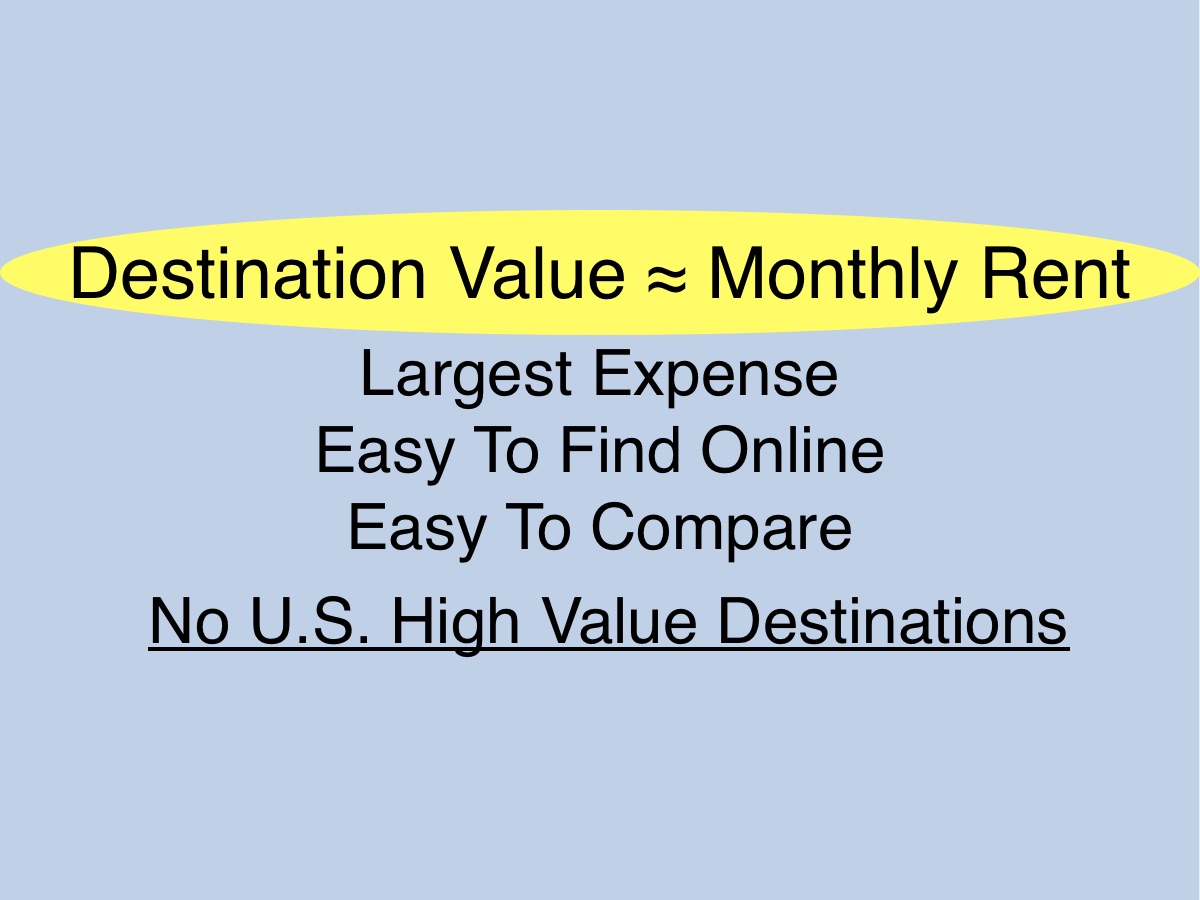
    The only cost data needed are high-season monthly rental rates because they are by far the largest expense for slow travelers.

    Therefore: Destination Value ≈ Monthly Rent

    High-season rental rates are easy to find and compare at online rental aggregators like Airbnb and Booking.com.  For example, I reserved a high-season rental in Costa Rica that scored high on all categories of my Destination Checklist. I compared this to available rentals for a similar high-season period in Honolulu, HI. There were acceptable accommodations in Honolulu but they started at 2.5 times the Costa Rican rental rate.  Costa Rica’s lower rent makes it a better Value than Honolulu for a slow travel destination.

    Rental rates overshadow all other slow travel costs like airfare and food.  High-season monthly rental rates are the only data necessary to determine Destination Value.  I am unaware of any destination in United States with high enough Value for me to slow travel to. There are many places outside of the United States that score high in all Checklist categories including Value.

    Plan Ahead

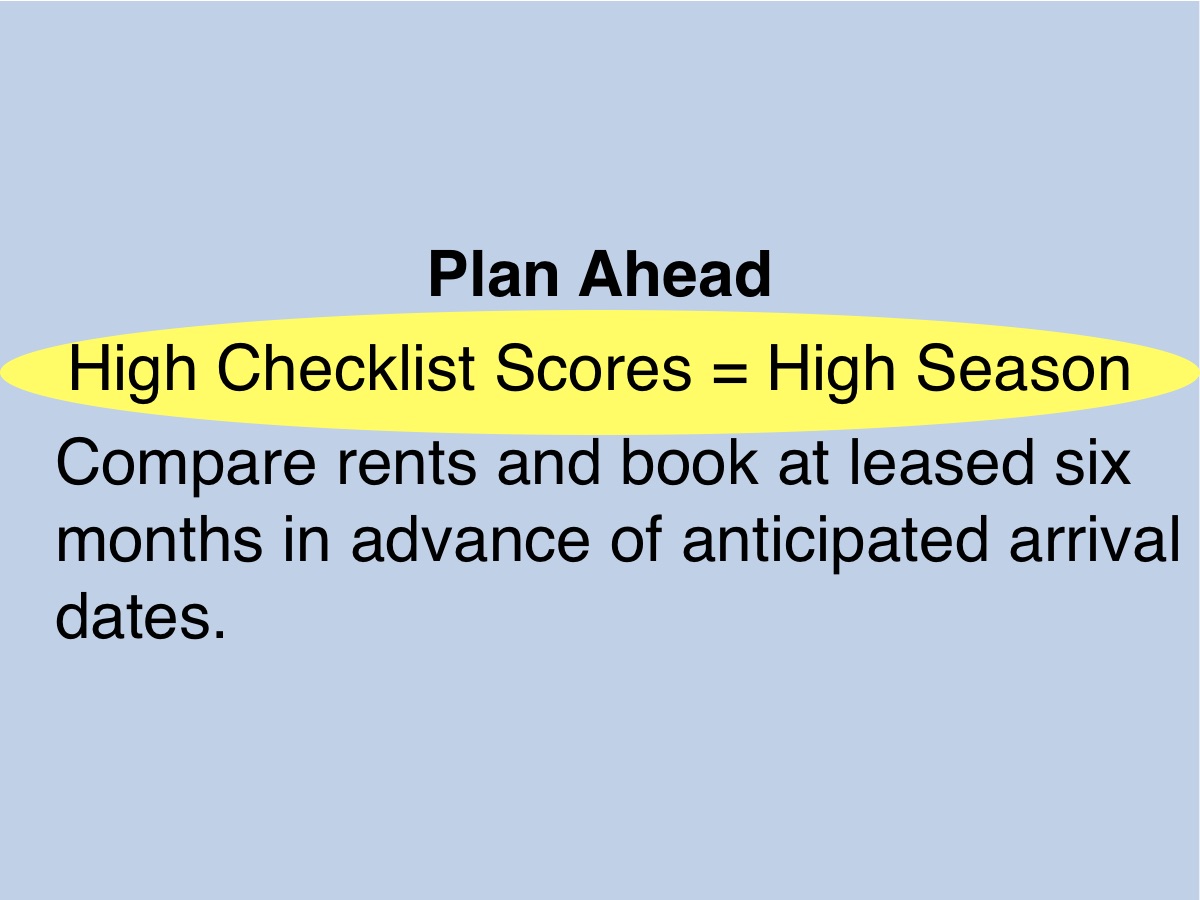
    Locations with high Destination Checklist scores are very desirable during Ideal Weather windows that span high tourist seasons and shoulder months immediately before and after.  Comparing rents and making reservations must be done well in advance of high-season to insure there are lots of vacancies to choose from. I compare rents and book accommodations at least six months in advance of anticipated arrival dates.  Booking late or after arrival does not work well for me.

    Choosing high Value destinations is a vital part of a slow-travel lifestyle that works well for me in my late seventies.  I am confident it will continue working well into the future.

    See my other posts for in-depth explanations of the all seven categories on my Destination Checklist.

    Please submit questions, comments and suggestions about slow travel and nomad living beyond 70.

  • Calendar

    Calendar

    Stan’s Calendar

  • Swim Club

    Swim Club

    Swim Club

    Who

    Anyone comfortable crossing the surf line and swimming in open water.

    Where

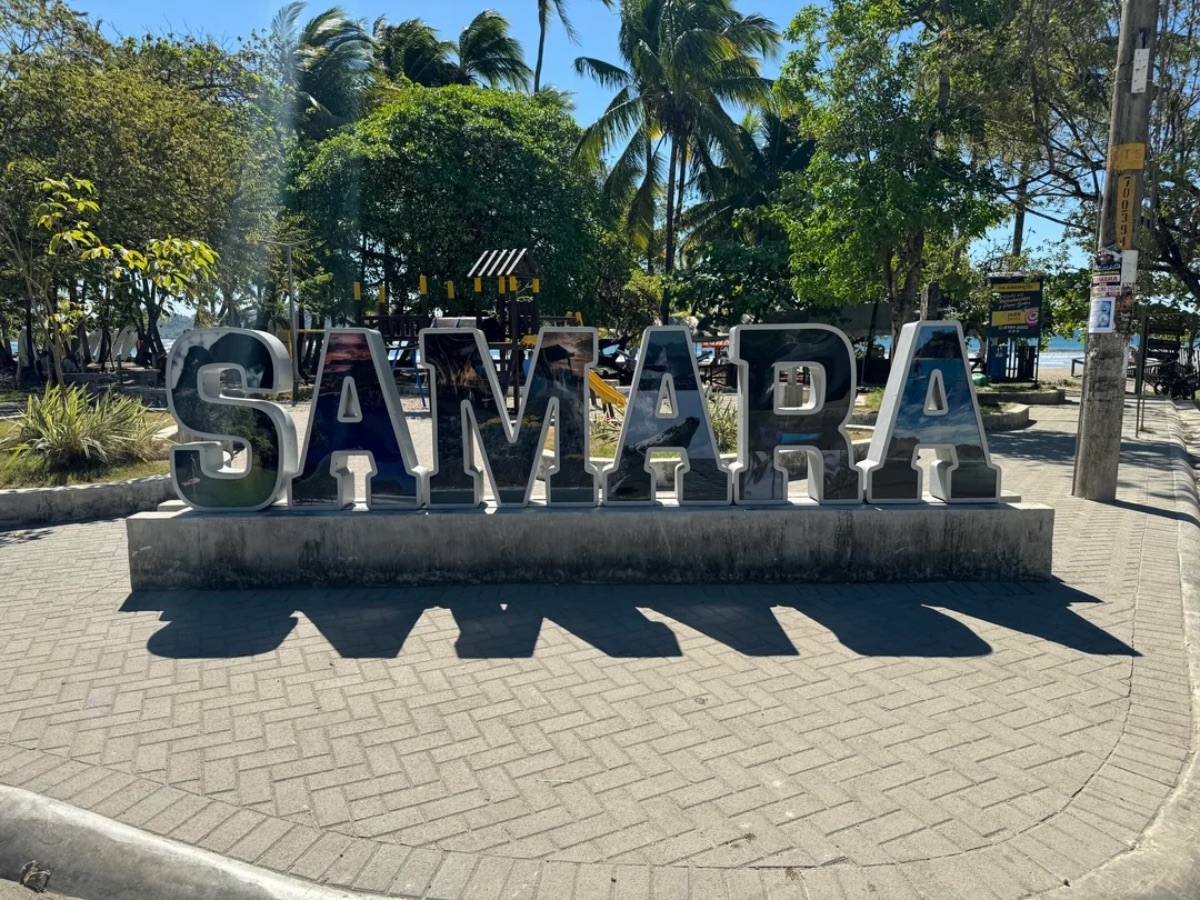
    We meet near the Sámara sign at the beach end of Via Arriba.

    When

    The Swim Club meets every morning at 06:30.

    Venue

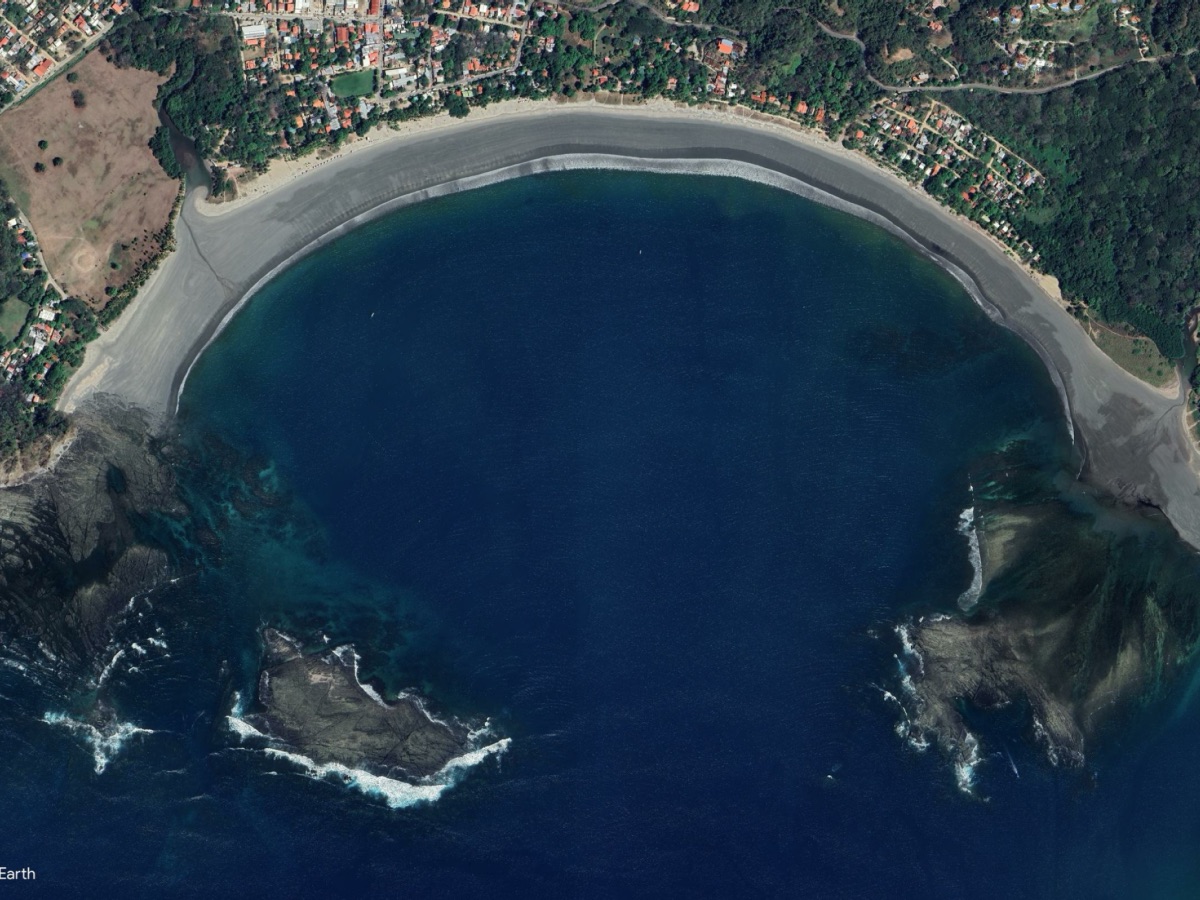
    • Oval shape venue with 1,800 m east/west by 1,200 m north/south axes.
    • Northern entirely points along 2,400 m gently sloping grey sand beach.
    • SW and SE ends bounded by rocky outcrops and reefs.
    • Southern exposure to open Pacific Ocean.
    • No detectable currents in north half beyond the surf line.
    • Tidal currents among southern reefs.
    • Tidal range can exceed 3 m (9.8 ft).

    Conditions

    • Best swimming is during dry season mid-December to mid-April.
    • Torrential rain during wet season washes enormous amounts of flotsam into the bay.
    • Under water visibility can be good (10 m, 33 ft) to poor depending on surf stirring up fine sand.
    • Minimal hazardous wild life: occasional invisible stingers, sting rays, red tide.
    • No sharks or crocodiles!
    • Very few powered water craft!
    • Entry is easier at low tide when surf is blocked by outer reefs.
    • “Surf shadows” created by reefs at east and west ends make entry and exit easier when surfers are smiling.

    Courses

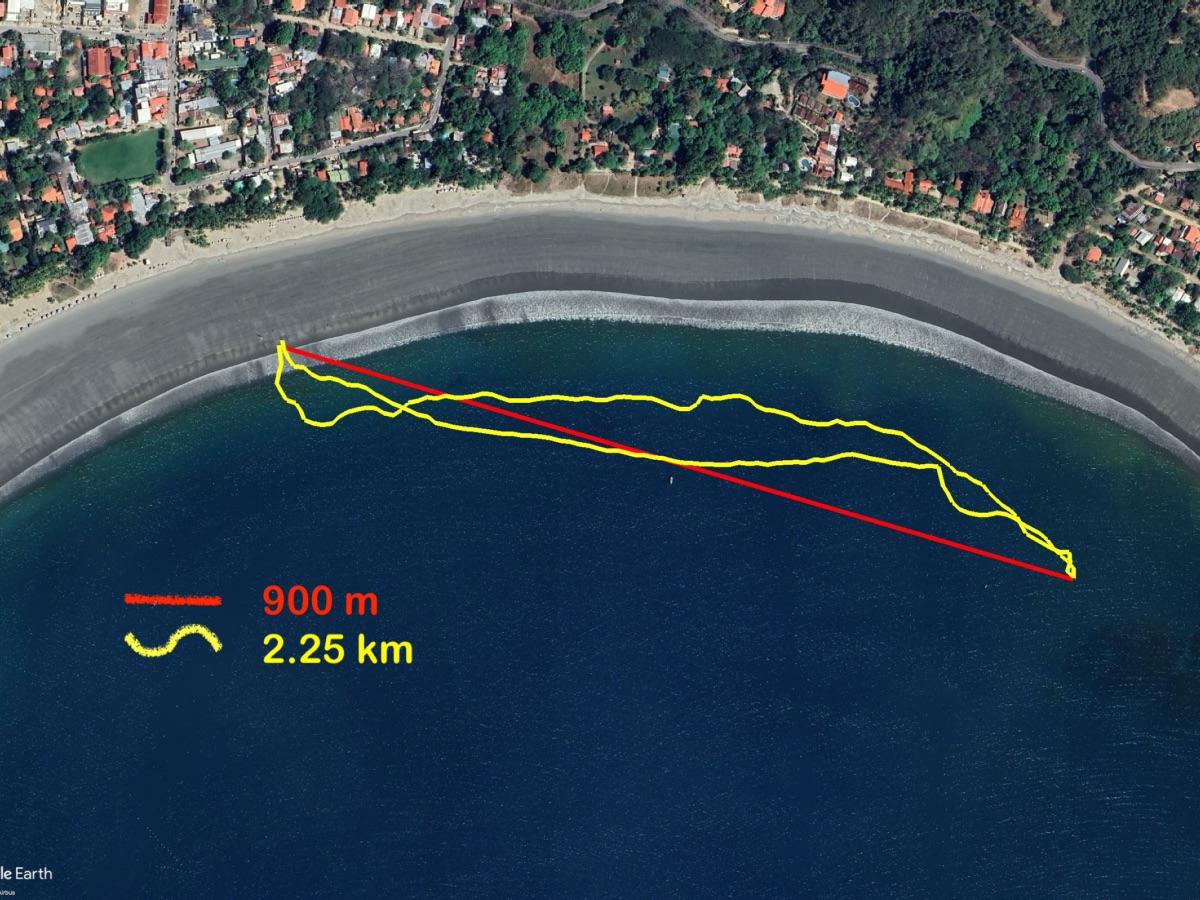
    There are several fixed marks in the bay. One is a yellow buoy approximately 900 meters from the start (red line). Swimming most of the way parallel to the beach allows swimmers to easily return to shore and walk back. The yellow line is the GPS track of a typical 2.25 km (1.4 mile) swim.

    What

    To bring

    Swimming googles.

    To not bring

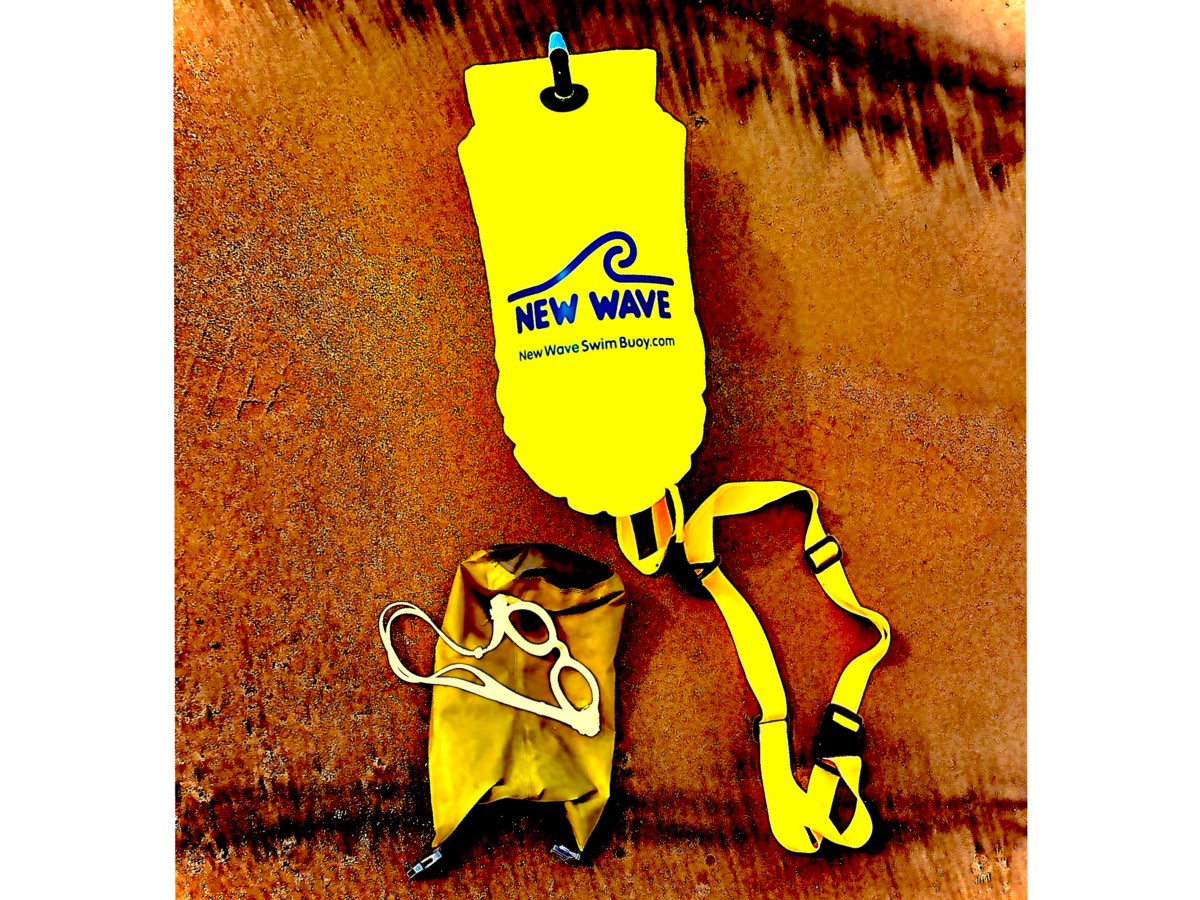
    Any valuables larger than a cellphone that will be left unattended on the beach. Cell phones, wallets and a few other small items can be towed in swim buoy dry bags.

    Optional

    Rash guard, fins, snorkel, towable swim buoy, wearable dry sack . . .

  • Website Flow Chart

    Website Flow Chart

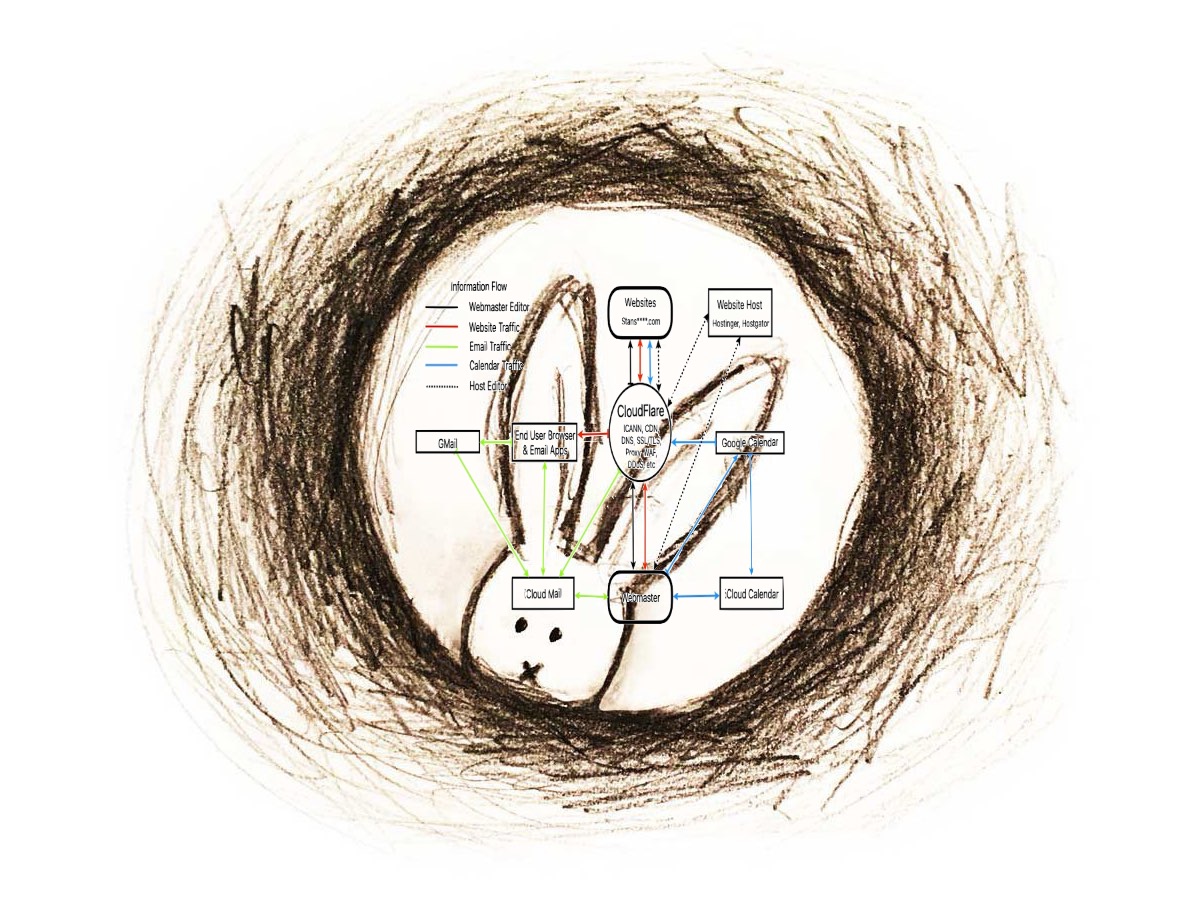
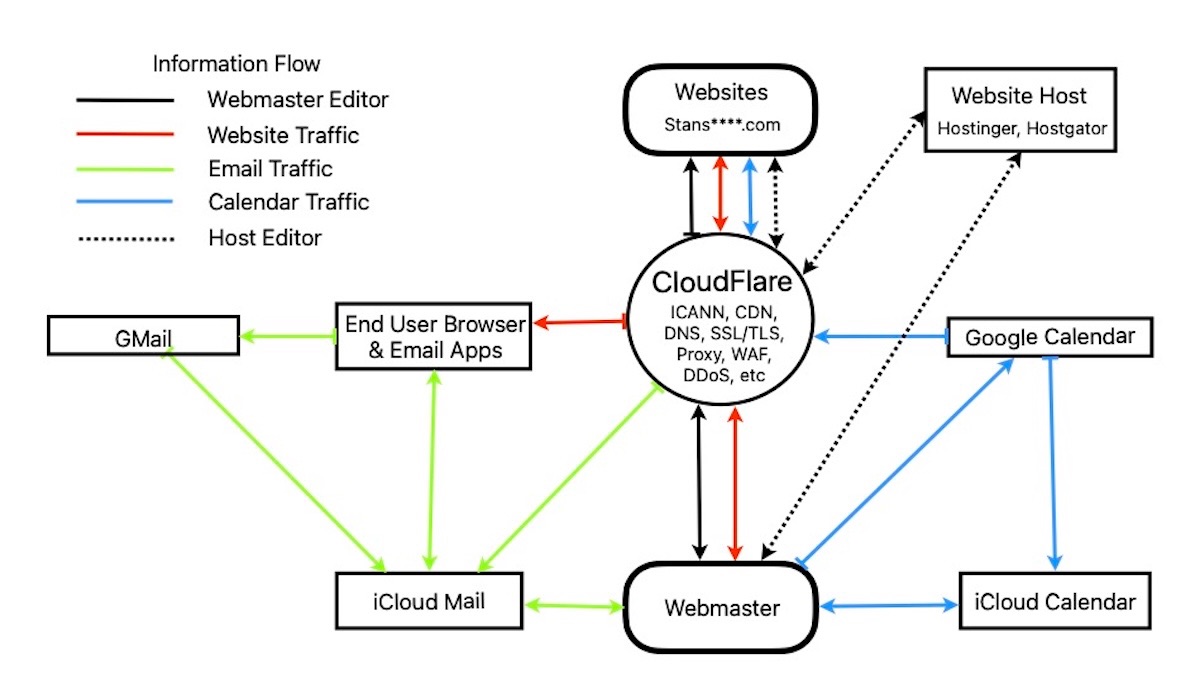
    The rabbit looking down the rabbit hole sees a flow chart of the server-side parts of my websites (see larger version below). It’s not necessary for the rabbit (me) to go down the rabbit hole to understand all the parts and the complex ways they interact. It is only necessary to know they exist and which ones to try tweaking to maximize speed, efficiency and security and lower cost and labor.

    It was a deep dive for me down the rabbit hole to come up with this scheme. I welcome questions, comments, criticism and suggestions about my choices.

  • More Beginner Dance Basics

    More Beginner Dance Basics

    I know about but not how to dance. These are impressions of an unskilled amateur dancer.

    As discussed in a previous post, the most basic dance skills required to physically express music are: identifying the pulse, finding the “one”, counting the beat and performing rhythmic body movements coordinated with the beat. Specific neural-muscular pathways are required that are different from most common activities. My biggest obstacle was the lack of these neural-motor skills necessary for dancing. This was clearly illustrated to me when a dance instructor asked me to listen to and vocally count simple dance music. My musicality was sufficiently developed at that time to accurately count the music with my voice. The instructor then asked to simultaneously tap my finger to the count without looking at my hand. I was then asked to look at my finger tapping while still counting out loud. There was absolutely no correlation between my verbal counting and my finger tapping. It was evident that I could correctly hear and verbally count simple dance music but the neural pathway from my ears to my finger was not adequately developed. The same result occurred when I was asked to tap my foot in time with the music. How could I expect to physically express music with my whole body (aka dance) if I could not perform the simple and most basic activity of tapping my finger or foot to the music’s pulse? The answer is training.
    All dancers use training exercises to develop and improve neural pathways that connect their body movements to the music. It is difficult for novice dancers to learn these techniques on their own. They are often taught them by dance instructors. To succeed, instructors need special teaching skills that, unfortunately, many do not have. The instructor’s bodies “speak the language” of dance but they are unable to communicate to novice dancers whose bodies “speak other languages.” Some “body language”crossover exists between dance and activities like gymnastics but little with every day activities like office work or driving a car. Dance movements are completely alien to many novice dancers like me. On the other hand, dance teachers often grew up with music, dancing or dance-related activities. It is their native body language. It is “in their blood.” They often feel naturally gifted and are arrogant and condescending to novice dancers like me. Having these teachers say “just listen to and move to the beat” meant nothing to me. I had to rely on other training techniques to develop neural-muscular pathways connecting my body to dance music.
    Musicians and dancers use all sorts of visual and auditory techniques to help them internalize musical structure. Pianists use metronomes to learn to play sheet music on time, ballerinas practice to taps of the master’s stick and conductors coordinate orchestral elements with their wands. My technique is to use computer apps like Audacity.app to simultaneously watch visual wave forms of the music while listening and moving my body to it.

    Watching wave forms to connect to music begins with visually identifying and vocally counting the primary pulses of the shortest repeating musical pattern. These pulses will always fall into repetitious patterns of either a single sound (single-count) or dissimilar sounds in multiples of two (two-count, “1 2”, “1 2 3 4”, etc) or three (three-count, ”1 2 3”, “1 2 3 4 5 6”, etc) The next step is to coordinate body movements to the vocal counting. The goal is internalize the basic musical structure into neural-muscular pathways (aka “muscle memory”) so that the body can eventually make specific movements exactly timed to the pulses without relying on external cues or counting.
    The most important fundamental body movement to the pulse are foot steps appropriate to the type of dance. Start with simple two- and three-count dancing with steps on every pulse. Good examples are merengue and waltz to, respectively, simple two- and three-count music. More advanced dancers will count and step to the pulses of longer and more complex “phrases” constructed repeating two- or three-count pieces. They may count, step and make other body movements not only on the major pulses but also on places in the music appropriate to the dance style, rhythm and individual expression of the music.
    An example a more advanced dance style is salsa “danced on the one.” The shortest repeating pattern is eight pulses. The leader’s basic pattern begins by stepping with the left foot on “1”, right foot on “2”, left foot on “3”, no step on “4”, right foot on “5”, left foot on “6”, right foot on “7”, no step on “8” and repeat. Beginner dancers may start by counting every pulse as “1”, “2”, “3”, “hold”, “5”, “6”, “7”, “hold” until they can confidentially step and hold with the correct foot on the correct pulse. The count can gradually be simplified to counting just the stepping pulses “1”, “2”, “3”, “5”, “6”, “7” or “quick”, “quick”, “slow.” The count may be further simplified to the “1” and “5”, just the “1” or no counting at all. The important thing to remember is every level of dancer consciously or unconsciously counts the music. Every level of dancer sometimes gets “lost” in the music and has to feel and count the pulses and find the “one” to get back “on” the music.